Monday, 16 February 2009

A Fool For Fruit Pt 2 - 'Too Much Of A Good Thing?'

A few rather vocal people in the raw food world have been warning all raw fooders of the dangers of what they describe as 'overeating fruit'. In general (the advice varies) they feel that we shouldn't be eating more than a piece of fruit a day. One quite well-known raw fooder voiced his opinion that eating 15 bananas was 'crazy'.

Well...the raw food diet itself is 'crazy' to a lot of people out there, so it's interesting to hear one raw fooder telling others that their way of eating raw is 'crazy'.

There are many people thriving on high-fruit diets who believe we cannot 'overeat' on fruit, and, you might expect that, as a fruitie, I'd be giving the same answer. However, my feeling is that it is certainly possible to 'overeat' fruit, in some circumstances. But, equally, there will be instances where eating a large quantity of fruit is very far from 'crazy'.

My Foolish Statement (see Pt I) included the words:

'is attracted to, has desire for, has appetite for, enjoys the taste of'.

And my premise is that we can use these concepts as measures to assess whether or not we are 'overeating' fruit.

But, before going any further, must stress I'm discussing 'overeating fruit' within the context of a raw food diet - that is, a diet where no cooked food is eaten. I've heard several people complain that fruit makes them feel 'bloated', but on investigation have found they're on a high-raw rather than all-raw diet. Now, the cooked food commonly eaten in high-raw diets is baked (starchy) root veg and/or cooked grains. If fruit is eaten with, shortly following, or even within a few hours of this sort of food, there'll likely be problems. Fruit and starch are not a good combination digestively; the starch may be incompletely digested, resulting in discomfort. Also, heavy food in general stays in the digestive system a relatively long time. Fruit digests quickly, wants to exit quickly, but its exit is blocked by the heavy food. Result - fermentation, gas, blow-up, even pain. But it's not the fruit that's the culprit - it's the cooked food! (Note those on all-raw diets may experience similar if fruit is eaten with or shortly after relatively hard-to-digest food, such as nuts.) So, if you hear people warning against 'too much' fruit, do enquire as to their own diets - have they really given fruit a fair test themselves?


***

That over with, lets say we're on a 100% (or almost...) raw food diet. We're enthused by those waxing lyrical about fruit. And they all look so sparkly-eyed, glowing, healthy, vibrant, and, as we're the type that never does anything by halves, let alone 'gradually' (what's that?!), we...launch right into it!


  • Day 1 We're following a menu plan because we want to do things perfectly - we're a bit anal like that (we ignore the word 'suggested'). Menu says 'kiwi fruit'. We're not that keen on kiwi fruit and would prefer papaya. But the plan says kiwi fruit, so kiwi fruit it is. Kiwis in soup, kiwis in salad, kiwis in smoothies...


  • Day 2 The plan says bananas today. We've had them for breakfast, in lettuce wraps for lunch, and look forward to reporting in to the fruitie forum on how many bananas we've eaten! The triathletes there seem to live on bananas. We run, don't we? But, although bananas were tasting good this morning, they're really not now...So we mix them with strawberries and make a giant smoothie. Six more down the hatch!


  • Day 3 We ditch the menu plan - we're an independent thinker! We see mangoes at the supermarket. They're ripe, look so beautiful -altogether very enticing. And...expensive. We notice nectarines have been marked down. Conscious that our partner has been commenting on the price of 'all this fruit' and that we'll win brownie points if we can show we've 'saved money', we leave the mangoes and buy nectarines. They taste bland.


  • Day 4 The big box of cherimoyas we ordered has arrived. We love cherimoyas and eat four on the trot. We don't have a great desire for any more, but they're quite soft, and will surely go off in a day or two, and we've had it drummed into us that on no account must we 'waste' food. So we eat another four. Then we feel a bit sick.
Spot the error this enthusiastic new fruitie has made?

(Any resemblance to characters living or dead, eg the writer of this blog, is entirely coincidental.)


In each case, we're eating either a large quantity of a fruit that we don't actually desire in the first place, or we're eating way beyond the point at which desire for it ceased. We haven't, to use an oft-misused phrase, 'listened to our body'. Instead we're eating for Other People's Reasons.

About twenty years ago, Severen L Schaeffer wrote a book sub-titled 'A Revolutionary Approach to Nutrition & Health', called 'Instinctive Nutrition'. In fact, the central idea is not so revolutionary. It's basically saying that we will, instinctively, be drawn to the foods that give the nutrients our bodies need at any one time. Schaeffer makes it clear that we can only be confident our bodies are drawing us if the foods we are attracted to are raw foods. If we're drawn to any other sort of food...that's our devious minds getting in the way!

Instinctive eating theory explains why sometimes a fruit will taste delicious to us one day, and perhaps 'so-so' the day after. And why celery may taste good on the first stick, but unpleasant by the third. Some vitamins and minerals can be stored, and our body's storehouses might be so full of a mineral contained in one fruit that we may experience no enthusiasm for it for months, but, when reserves run low, develop a passion.

Schaeffer also tells us to look out for the alliesthetic 'taste change' that occurs when our body has had enough of whatever nutrients a particular food gives us.

Let's say there are 15 bananas in the kitchen. They're very spotty and will be past their best soon. Schaffer's theory says that if we really feel like those bananas we should start eating! But we should stop eating at the point at which the bananas stop tasting good to us. (Note that if we try to disguise the taste of the bananas by whizzing them up in a smoothie with other things, we are unlikely to be able to detect the taste-change point.) If we are still enjoying the bananas after the sixth or seventh, then - sure - eat more! But the theory also says that, if we really don't feel like eating them at all, it's far better to throw them out - put them on the compost - rather than put them into our bodies.

So, we shouldn't be eating large quantities of any fruit (or indeed any raw food) if true desire is not present. One of my favourite books of dietary (and non-dietary) instruction - The Essene Gospel of Peace - says 'for all that you eat...without desire, becomes a poison in your body.'

If we eat large quantities of a particular fruit when our bodies haven't set up any significant desire so to do, we could receive too much of certain nutrients, and not enough of the ones we do need. I'm not suggesting that problems would necessarily be serious, but could be enough perhaps to make us feel a little out of sorts and (incorrectly) deduce that the high fruit diet 'isn't working'.

Some people are concerned that they might obtain 'too much' potassium on a high-fruit diet. Although significant symptoms of potassium overload, even in those on high-fruit diets, are unknown, a fruitie expert told me that it is possible (although rare) that someone making an overnight switch from a diet with added salt to one without any might have a temporary excess of potassium in the short-term while their bodies are adjusting to the change. However, 'instinctive eating' theory does rather come to the rescue here, in that if we eat only those foods for which we truly have appetite, we have a built-in safety valve. As, if the body of a high-fruiter raw fooder really did have too much potassium, then it should set up a desire for, motivate a search for, fruits and other plant foods that are relatively low in potassium, and, say, higher in sodium, and if we follow our true appetites and select fruits we're truly attracted to rather than eating for Other People's Reasons, we should be OK.

A Fairtrade Banana Eating promotion was to have had an event where one million bananas would be eaten by 10,000 people - 100 each. It was stopped by doctors who said that high amounts of potassium from so many bananas could be fatal. I agree with the doctors. This would be a great example (glad it didn't happen) of people eating huge quantities of bananas almost certainly way past the point of true desire, not because they felt like doing so, but...to create 'news' for a promotion. But, if someone genuinely felt attraction and appetite for 100 bananas...

The high-fruit diet should, therefore, work beautifully for us, provided we select only fruits for which we have genuine desire, and stop eating them when that desire is no longer present.

And the good news is that nature has provided us with a variety of fruits from which to choose, and they will contain different levels of vitamins and minerals. And, sure, the majority of them don't grow near me in the UK, and I'm very glad that those living in the parts of the world that we migrated from thousands of years ago are sharing them with us!

Here's a beautiful account of 'instinctive eating' in action:

Victoria Boutenko ('12 Steps to Raw Foods'):

"When my family had been on raw food for two months, my children began craving different fruits. Sergei asked for mangoes and blueberries and Valya asked for olives and figs. The kids' cravings were so strong. I had to hustle to keep up with them. For example, I gave Sergei a mango. He ate it and wanted more. I bought him a whole case of mangoes thinking that would last him a week. He sat down and ate the entire case in a day, skin and all. He then said 'I wish there were more mangoes,' so I bought him another case.

The same thing happened with blueberries. I bought him a two-pound bag of blueberries and he ate it in one sitting. Valya liked figs. She'd ask for fresh figs, dry figs, black figs. She could never have enough figs; she also liked eating olives. During our travels that spring, we visited our friend Marlene. Marlene had a beautiful olive tree. There were olives underneath the tree already starting to rot. Valya said, 'I want to try them. Oh they are delicious.' I tried them. To me they were too bitter. Valya enjoyed the olives so much that she gathered them up in plastic bags to take with us.

The next step on our trip was a visit to Dr Bernard Jensen, a world famous clinical nutritionist. We asked Dr Jensen what Sergei needed to eat for diabetes. He looked in his books and told us that the best thing for diabetes is mangoes and blueberries. Wow. Then we asked him what Valya needed to eat to help her asthma. He said figs and olives."

How sad it would have been if Victoria, as a new raw fooder, had said to Sergei, 'Well, the raw food expert, X, warns that too much fruit isn't healthy, so one mango's all you're allowed.'

If our bodies are telling us, via desire, via taste, via pleasure, that a relatively large amount of a particular fruit is right for us, I suggest we eat in line with their directives. As, if we don't, and stop before their needs are satisfied, we will be dissatisfied. If we obey the diktats of someone else rather than the calls of our bodies, we could run short of certain nutrients. Some theorise that in these instances the body will then set up a search for what's missing. We may prowl around for more food, in a bid to find those missing things, and will be soft targets for the seductive calls of the mind...'aha, the raw food diet isn't satisfying you, is it?'

So, in short, let's eat lots of fruit if we have a genuine desire for that fruit, and enjoy every bite! And, if we don't, let's not.

And that's why I feel it's a pity to hear a raw fooder tell other raw fooders that eating 15, 30, whatever, bananas is 'crazy'. If, say, an active person has a desire to eat that many in a day, then what would be wrong with that? (By the way, a lot of high-fruiters 'mono-eat', that is, eat just one type of fruit in a day, or for several days, until their bodies signal a desire for another food - see 'Mono-eating - Or Just Eat An Apple Or Five'.)

But, the 'fruit warners' say it would be wrong to eat that many bananas (and if anyone's heartily sick of the b-word, substitute any other fruit!). They warn, either explicitly or implicitly, of all sorts of health horrors in store for those 'overeating fruit.' In Pt 3, I'll be discussing further whether there is justification for making healthy people on a raw food diet nervous of eating more than a piece of fruit a day.

Coming next...

A Fool For Fruit Pt 3 - Should Fruit Eating Carry A Health Warning?

Thursday, 5 February 2009

A Fool For Fruit Pt I - The Fruit Warners

Too many times now, raw fooders have contacted me via the RawforLife website and said that they are 'eating very little fruit'. Why? Because they've been persuaded that anything more than a small amount of fruit, perhaps a piece a day, is 'over-eating fruit', and will result in all sorts of adverse health consequences.

A few days ago, after encouraging a raw fooder to eat all the fruit she desired, and feeling elated at her evident relief and joy, it was a tad depressing to see a host of messages on raw food forums issuing strong directives not to 'over-eat' fruit, and even saying that high-fruit diets are dangerous. Not even 'can be', or 'in some cases', but 'are dangerous.'

Now, the posts did contain advice (non-fruit-related) that made good sense, and, if acted on, could have a beneficial effect on the health of many reading. But these statements warning everyone about eating what was described as too much fruit run counter to the experience (and that includes long-term experience) of those on high-fruit diets. One poster named three people who shared his opinion and informed readers that 'it is foolish to claim they are wrong.'

Well, throwing caution to the wind...here's my Foolish Claim about fruit:


'If a healthy person (that is, a person without a serious pre-existing health problem*), on a raw food diet, is attracted to, has desire for, has appetite for, enjoys the taste of, what most would consider a large quantity of 'fruit in general', or a particular fruit, then it is healthy (not dangerous) to eat that quantity.'

*and there is evidence to suggest eating lots of fruit will be no problem in at least some of those cases - more in future Parts.


In other words, I'm suggesting that, in the majority of cases...

if someone feels like lots of fruit, and they eat lots of fruit, that's not 'over-eating fruit'.
if someone doesn't feel like lots of fruit, and they eat lots of fruit, that could be 'over-eating fruit'.


Those warning everyone about the (according to them) dangers of fruit-eating have become increasingly vocal. In many cases this is causing unnecessary anxiety to those new (and not so new) to raw food. I especially feel for those for whom the discovery (or rediscovery) of the delights of fresh fruit played a major part in their going raw (and in the transformation of their health), and are now bewildered.

It's sad to see those people drastically reducing their consumption of a food they so enjoyed eating - one of the very best things they can give their bodies - and at the same time spending a fortune on 'superfoods' and supplements (see 2008, August archive).

For the purposes of discussion, I will be using the terms 'high-fruiter' and 'fruit warner'.

Definitions as follows:


High-fruiters

Raw fooders for whom at least two-thirds of food (by calories - roughly!) is fruit.

This group includes '811'ers - those who follow the teachings of Dr Doug Graham, who advocates at least 80% fruit. High-fruiters generally also consume high quantities of green leaves (an athletic man might consume several heads of lettuce a day) and a little fat (in the form of nuts, seeds, avocados etc). Note the majority are not fruitarians, or at least not in the sense that the world would understand the word. They don't live on fruit alone; their diet is fruit-based.

Generally, this group believes that the raw food diet can supply all the nutrients needed by their bodies and that, although a few supplement for B12, in general supplementation should not be necessary.


Fruit Warners

Raw fooders who eat very little fruit and warn others not to 'over-eat' fruit.

They also tend to consume lots of green leaves, but generally have more fat than the high-fruiters. Some follow a 'Hippocrates'-type diet, high in sprouts and wheatgrass juice. Some include cooked food, so would be more accurately described as following a 'high-raw' diet rather than a raw food diet.

Generally, this group believes that the raw food diet cannot supply all the nutrients needed by their bodies, and most, if not all, supplement - not only with B12, but also with various green (and white) powders, liquids, dried algae etc.


Note here we have a negative correlation. The more fruit eaten, the less the perceived need for supplements. The less fruit eaten, the more the perceived need for supplements.

Here's another. The more fruit eaten, the fewer supplements taken. The less fruit eaten, the more supplements taken.

Of course, correlation does not imply causality.


Division, unity...

Wouldn't it be great if raw fooders could forget their differences and come together in the interests of unity? Then perhaps the most vocal could focus simply on communicating those things we can all agree on. 'Eat raw!' springs to mind.

In fact, there was a meeting, held at the Hippocrates Institute, with the objective of promoting 'unity' in the raw food world. This is a laudable aim, and hats off to the person who came up with the idea. As the meeting was held in 2006, this is old news, and I wouldn't be mentioning it were it not for the fact that the meeting was referred to in a recent 'fruit warner' post, and those who have gone raw since 2006 might like to know more.

The meeting, billed as a 'historic Summit' included raw food leaders 'from eight countries', and was set up for 'establishing scientifically common standards for optimum health.' At this meeting, various 'standards' were agreed, amongst which were ones we can surely all agree on, eg the optimum diet should be 'high in nutrition', 'provide excellent hydration', etc. But 'standards' also agreed were:

'the addition of superfoods and wholefood supplements is advised', and that (the raw food diet should) 'contain only low to moderate sugar'.

The second of these effectively vetoes the high-fruit diet! And in so doing, is at odds with the teachings of many well-known raw food 'leaders', not to mention the diets of thousands of raw fooders all over the planet doing very well on high-fruit diets.

So I decided to find out a little more about the delegates (or at least the US/UK ones) who 'agreed' these 'standards. I found that several followed the 'Hippocrates' low-fruit diet and that some had businesses selling supplements. Fair enough. However, absent from the delegates list were high-fruiters, who of course by definition would never have given their agreement to the first of the two 'standards' quoted above. Neither did the list include any Natural Hygienists. who favour a high-fruit raw diet, and are also unlikely ever to have agreed (if they had been present) to the second 'standard' on superfoods and supplements either.

Unfortunately, Dr Doug Graham, one of the world's best-known raw food leaders, and an advocate of the high-fruit diet, was unable to attend, as the meeting was held in January, and he holds his Costa Rica retreats in January. But there are many other high-fruiters in the raw food world who surely could and should have been invited. Apologies to the organisers if in fact they were invited, but couldn't attend. (And if so, what a pity).

Now, I'm not sure that that panel of delegates would have been representative of opinion in the raw food world three years ago, and it certainly isn't now. Although I know this wouldn't have been the intention, referring to this meeting in a 2009 'fruit warning' communication does have the potential to confuse, as not everyone is going to notice the small print, eg the date (I missed that first time around!), and it could certainly give the impression to many that these 'standards' are consensus amongst 'raw food leaders' today, when patently they are not.

So, I very much hope that, should this Summit be repeated, the list of delegates can be more representative of the divergence of opinion in the raw food world on fruit (and supplements, for that matter). Dr Doug Graham is an obvious candidate for an invitation. But there are many other names that would qualify and should be considered by anyone planning such an event in the future. Some of them are luminaries, some aren't. Some have letters after their names, some don't. What they all have in common is that they are living testimonies to the high-fruit diet and, whether or not they have businesses, have written books, made videos, are all teaching others in various ways, if only by good example. (And if no one else can make it, I can! Quite fancy a trip to Florida.)

***

Now, one way in which I differ from certain other fruit enthusiasts is that I believe people can thrive on all sorts of raw food diet, and that high-fruit isn't the only way, or even the best way (is there even a 'best way'?). This is based on my observations of others, and my own experience. I spent the first year of raw very happily on a relatively-high-fat, raw gourmet, raw choc, lowish-fruit sort of diet. I felt healthier than since childhood, all sorts of ailments cleared up, and I had no problems staying raw (certain 811-ers who have difficulty believing that's possible on any diet but 811 will have to decide whether I'm a fibber or an oddity).

My own diet is around two-thirds fruit - on average. Some days I seem to live on persimmons. Other days just a little fruit. But I'm eating a lot more fruit now than when I first discovered raw. Why? Firstly because the longer I've been raw, the more fruit I've desired. Interestingly, it was only after moving from 95% to 100% raw that I fell in love with fruit completely, and my body started singing for it!

Second reason for eating more fruit? Vanity. I noticed that the high-fruiters looked particularly healthy and vibrant. In general.

So - I like lots of fruit. Others I know don't. Fruit doesn't rock their boat. And they're doing fine on that. There are accounts from history that suggest that human beings can thrive on all sorts of plant foods (and even two or three foods only) as long as they're not damaged. So, all sorts of raw food diet can be good. I can think of lots who are great examples of the raw food diet who don't eat much fruit.

Some people start low-fruit and then switch to a diet that includes more fruit, and prefer that - it suits them - that's the sort of diet that keeps them happy on raw. Some people start high-fruit, then switch to a diet that includes less, and prefer that - it suits them - that's the sort of diet that keeps them happy on raw.

But, some people who've chosen to eat very little fruit seem to be so convinced that they are 'doing raw right' and others are 'doing raw wrong' (and, so, might I add, are some of the high-fruiters as well...) that they are expending lots of energy telling those who do have an enthusiasm for fruit that not only should they not 'over-eat' fruit but are warning them either directly, by association or via hints, that all manner of awful things are likely to happen to them if they persist in this unhealthy practice.

I don't think it wise to eat large quantities of a fruit just because someone else has convinced us it's a good idea, or to try to meet a calorie target, if one does not genuinely desire that particular fruit in that quantity (see Foolish Claim earlier). I can see that, in a small minority of cases, an individual's past medical history may 'contra-indicate' the consumption of a large amount of a nutrient in a particular food. I also think it possible that such an individual's body might not set up a desire for large amounts of that food anyway. But - sure, a debatable, and hope you'll stay with me for when I discuss that in future Parts.

But the fruit warners are issuing blanket directives - they are saying 'you should not'. Ever. To everyone. Without knowing anything about the size, energy requirements, nutritional needs, physiological quirks, general state of health, appetites or taste preferences of their 'audiences'. They may have their opinions as to what is or isn't 'the ideal diet' but to start frightening healthy raw fooders who love and are obviously thriving on fruit into 'limiting' their fruit intake, to have people start to feel anxious about eating fruit for goodness sake, and to say that high-fruit diets are dangerous, is going too far.

And, although I'm only a small voice compared with some, I'll not sit back and watch people who do desire lots of fruit, whose bodies are crying out for it, denying themselves fruit, thinking that they 'shouldn't' have more than one mango, finish the punnet of cherries, spend a day mono-eating bananas, whatever, because of the pronouncements of what amounts to a very small group of people, without speaking out.

I've not come across any research yet that persuades me that blanket warnings to everyone saying 'you must not over-eat on fruit' are justified. I've not come across any research that suggests that it is correct to warn people in general not to have more than one piece of fruit a day. I've not come across any research that advises an average, healthy person to limit their fruit consumption, and that 'too much' fruit is 'unhealthy'.

I'll be looking at this in more detail in future Parts, but just a few points about...


Studies

If you ever hear someone refer to a 'study' that has linked fruit with such-and-such an ailment, find out if the study was actually about fruit.

Was the study about fruit, or was it about sugar? 'Sugar' covers a multitude of toxic substances, eg sugars extracted from foods (not just fruit of course), that is, stripped of the nutrients and fibre that came with them then heated, sugars processed into syrups, combined with additives etc. I'd guess 95% of the 'sugar' ingested by the average person (on a standard cooked diet) in a scientific study is not going to have been consumed within a fruit.

Was the study about fruit, or was it about fructose? Fructose is the name given to the sugar in fruit. But if the fructose ingested has been extracted from fruit, it has not been ingested in its naturally-occurring form. My googling reveals that fructose as found 'normally', that is, within fruit, is handled easily by our bodies. It's when it's extracted from fruit then added to other foods, usually as a 'sweetening agent' and sometimes as a preservative, that problems arise.

Was the study about fruit, or was it about fruit juice? Fruit juice is a fractured food; it is part of a fruit. And I'd guess that the fruit juice ingested by the people in these studies will have been pasteurised (cooked).

A raw fruit is a package of nutrients, all of which are there in precisely the right proportions to work together well in our bodies. The sugar is part of the fruit, and is there along with all the other vitamins, minerals, other nutrients (including some that scientists might not have even discovered/named yet), and the fibre.

High intake of unnatural substances like refined sugars, fructose (isolated from the fruit) and fruit juice will cause problems for the body.

But if anyone can show me a study that is truly scientific, that is, using good sample sizes, with carefully-matched control and experimental groups, or perhaps a longitudinal study of 'high fruit eaters' v 'low fruit eaters', that supports the idea that high consumption of whole fruit is unhealthy, please let me know; I can easily build it into the subsequent Parts of this article where I will be discussing the various health issues the Fruit Warners would have us believe that raw fooders as a group are going to run into if they 'over-eat' fruit (and if you're a bit late, I can edit).

As, I haven't found one yet.


Disclaimer: Debbie Took is not a doctor. Please assume she is talking out of her bottom. Anyone who is tempted to eat lots of fruit on the basis of this article is advised to consult a health professional first.

Coming up:

A Fool For Fruit Pt 2 - 'Too much of a good thing'?

Tuesday, 27 January 2009

'Healthy cooked food' - a contradiction in terms

When I first went raw, the words 'healthy cooked food' would have been the last anyone would have expected to hear from a raw fooder's lips. But in the last year or two things they have been a-changin'... 'Cooked food is poison' isn't pc. People say it alienates, antagonises. Although I suspect any disadvantages might be cancelled out by the advantages of 'shock-value', OK, I'm willing to go along with the current train of thought on that one. But now the pendulum's in danger of swinging just a little too far the other way; I'm hearing an increasing number of raw foodists (including some quite well-known ones) talking of 'healthy cooked food', and...I think a rallying call's due, troops!

We all understand the term 'healthy cooked food' as used by the world out there, and as used by ourselves before we went raw. It's used sometimes when describing a food that's preferred, for health reasons, to other foods in its group. For example, omnivores might describe fish as healthy compared with beef or pork. Or, it might be used to describe foods cooked in a way that minimises nutrient loss. For example, steamed vegetables might be described as healthy compared with fried or roasted.

It's great news to hear raw food teachers encouraging people not only to increase the raw in their diets, but, recognising the majority are not going to be going 100% raw, or at least not this week, also advising that, when cooking, people choose the gentler cooking methods. It's only when raw fooders use the words 'healthy cooked food' that I take issue. As, these words are not only inaccurate, but they confuse, and instead of leading people (gently, in time...) towards our core message, it could lead them away, that is, back into a mainly-cooked diet where they feel there is no need to make any further changes as, because it's (for example) mainly steamed and baked food, it's 'healthy'.

The words 'healthy cooked food' dilutes our message. What are we so afraid of? I'll discuss that later, together with some suggestions as to what words we could use to help the people we want to help yet not compromise on what we have learned to be true.

For anyone who has any doubts that 'healthy cooked food' is a contradiction in terms, please consider the following. And anyone who has no doubts - perhaps this will help you make your point when next you hear a raw fooder use those words.

All cooked food is damaged to some degree. All methods of cooking damage and/or destroy precious nutrients in our food. And because cooked food has nutrients missing, those present are in different proportions than those the food was designed to give - that is, too much of certain things and not enough of others. This imbalance has consequences for our bodies. As we know from chemistry lessons, chemicals need other chemicals in precise proportions for specific reactions to occur. And if something is missing in a food (eg B vitamins in cooked grains) our bodies may raid their own reserves in order to metabolise other substances in the food.

The foods that are most often described as 'healthy cooked foods' are steamed vegetables, and baked root vegetables, eg potatoes, sweet potatoes. They may be 'healthy' from a cooked-food-eater's point of view, in comparison with other cooked foods, and, sure, there's a difference between steamed courgettes and a deep-fried Mars Bar, but how can a raw fooder, someone who understands what cooking does to our food, describe these cooked foods as 'healthy'?

STEAMING

When steamed, food is heated to a very high temperature - 212 degrees F. Oxidisation is a big problem, with nutrients carried off in the steam. Contrary to what some claim, vitamins are also lost to water, as water usually collects at the bottom of the steaming bowl.

From old sources: A study at the University of Wisconsin showed that cabbage, when steamed, lost 22-43% of nutrients (amongst these - protein and calcium). Ragnar Berg ('Vitamins'): 'the mere steaming of vegetables for five minutes dissolves out so large a proportion of the inorganic bases that the residue contains an excess of acids.'

More recent sources say that steaming destroys various vitamins, most notably Vitamin C. And in a study published by Journal of the Science of Food Agriculture, researchers investigating effects of various means of cooking broccoli found that steaming caused an 11% loss in certain antioxidant compounds.

Sure, steaming may not be as bad as boiling. But still not a 'healthy' thing to do to our food.

Edit May '10 -

I offer you this contribution to the 30BaD forum from 'Carl Andrews':

'One of my brothers is a top ranked chemist here in Texas who runs a large water municipality. Although he is a SAD [standard American diet]eater himself, he was telling me some interesting things this past weekend about testing for chemicals in food, acrylamide in particular. It turns out tests conducted by the World Health Organization did in fact show acrylamide in boiled food.

My brother explained the confusion over it. Yes, acrylamide has in fact been found in boiled and steamed food - and at higher concentrations than the EPA deems safe in drinking water. He said the only reason it isn't always found in boiled food is because the two tests used for acrylamide in food are notoriously insensitive. They are almost useless at detecting concentrations below a certain level. The significant detail, though, is that almost every level below those test-detection ranges is still considered a carcinogen by the World Health Organization. As soon as a more sensitive test is had, my brother says - and the EPA has recommended that one be developed due to the "inadequacy" of the current tests - as soon as a sufficient test is available, boiled and steamed will officially join all other cooked foods as containing cancer causing levels of acrylamide. The upshot: anyone eating boiled or steamed food thinking he isn't getting acrylamide, and at carcinogenic levels, is fooling himself...'


BAKING

When baking, food is cooked to extremely high temperatures - anywhere from 300 to 600 degrees. Protein is denatured, rendering it less assimilable by the body.

Vitamins are destroyed. Arthur M Baker, MD and naturopath: 'vitamins are heat-labile, with thiamin (B1) and vitamin C being the most susceptible to baking losses. When the pH of the baked product rises above 6, nearly all of the thiamine is destroyed. In high-protein cookies, calculations revealed thiamin losses exceeding 90%.' (When B vitamins are cooked out of our foods, our bodies will raid their own reserves of them in order to metabolise the food.)

Arthur M Baker again: 'Bake some yams or sweet potatoes. Notice the sweet sticky goo oozing from the skin that partially turns to ash from the excessive heat. You're witnessing sugar molecules (carbohydrates) caramelising, fusing together like sticky molasses. Similar to protein coagulation, caramelization also occurs on a microscopic level when all foods are sufficiently heated, whether or not it is witnessed. When complex carbohydrate sugar molecules are caramelized or fused together, amylases (digestive enzymes) cannot cleave them into constituent simple sugars for use as an energy source. Not only are they unavailable, but the heat turns them into an ash-like toxin.'

Baking is one of the cooking processes found by scientists to produce acrymalides, linked with various forms of cancer. And laboratory studies suggest acrylamides could be the cause of 'benign and malignant stomach tumors and damage to the central and peripheral nervous systems. Acrylamide occurs in baked potatoes,...' (Gabriel Cousens, 'Rainbow Green Live-Food Cuisine'). Acrylamide forms when certain carbohydrate-rich foods are fried, baked or roasted.' Note that it has been found that acrylamide levels appear to rise the longer the food is heated (not a great ad for slow-cooking).

So, baking might not be as bad as roasting, deep-frying or barbecueing. But it's not a healthy thing to do to our food. (Oh and if anyone says to you 'but potatoes have to be cooked', there's an answer to that - here.)

Blanching

Before summing up, a word or few about 'blanching'. Not quite in the same category as steaming and baking, as we can all agree these are methods of cooking. But, some people seem to think 'blanching' isn't cooking.

And 'blanching' is most certainly cooking.

Recently, I heard a raw food chef instruct readers to pour 'nearly boiling water' over green veg, leave it soaking 'for one minute' and then 'plunge it into cold water' (the idea being to tenderise the veg and give it a bright green colour). He then said that this would not 'negatively affect the nutrients'. Perhaps he felt that because the veg would not continue to cook in its own heat once immersed in cold water that no damage would be done?

'Blanching' will most certainly 'negatively affect nutrients'.

Vegetables that are blanched before freezing (a common processing technique) can lose up to one-third of their antioxidants (US Journal of Science of Food and Agriculture). A study of blanching of artichokes carried out by University de la Frontera, Chile, 1997, showed a 16.7% loss of Vitamin C. A study of blanching of potatoes carried out by Loughborough University of Technology 1989 showed nutrient loss. 'Depending on the method of blanching, commodity and nutrient concerned, the loss due to blanching can be up to 40% for minerals and vitamins' (Food Processing, Principles and Applications - Ramaswamy & Marcotte 06).

And I carried out my own experiment by plunging some soaked mung beans in 'nearly boiling water' for 'one minute', then seeing if they would sprout. I sprout mung beans regularly, and, always, within a few days, I have a jar full of long-tailed sprouts. But this time, after three days, 90% of the beans had failed to sprout.

But, really, do we need these scientific studies, or our own experiments, to tell us what should be pretty obvious? We all know that various nutrients are lost in boiling water, paricularly Vitamin C and B vitamins. Raw foodists know from various studies that nutrient loss starts to occur when food is heated at somewhere between 105 and 120 degrees Fahrenheit! So how can there be no nutrient loss when vegetables are cooked in 'nearly boiling water', even if it is only for a minute?

If I was immersed in 'nearly boiling water' for 'one minute', then placed in cold water, I don't think I'd be 'refreshed'. I think I'd be...dead.

So please be content with the colour of veg in their natural state, and, if a vegetable is too tough un'blanched', then don't eat it (or perhaps spiralise it). 'Blanching' is cooking.

*****

So, returning to the steamed veg, baked potato thing - 'healthy' cooked foods? Sure, 'healthy' as the world understands it, but raw foodists know better.

Now, it's at this juncture that I need to stress a few things, to minimise the chances of my being misunderstood.


  • Is a high-raw diet with a little steamed/baked food a good diet? YES! It's light years ahead of the average diet health-wise. If I could get half my family and friends onto such a diet I'd die happy (well, hope I die happy anyway!).

  • Is it a good idea to help those who are not ready and/or not willing to go raw to stop eating the most harmful foods and replace the most destructive cooking methods with less (or at least marginally less!) destructive cooking methods? YES! And if what we say and do has helped them make good decisions we'll have done them a huge service, and may have helped transform their health.

  • Am I just bashing those who choose to eat a little cooked food? NO! There are many who feel that the inclusion of a little cooked food gives them just the flexibility they need to stay, happily, 'high-raw'. And that's nothing but good! And it may be that eating all that raw makes up for any deficiencies/imbalances in the cooked food and that their bodies have sufficient energy (from the raw!) to detox any toxins created via normal daily detoxing. But - that still doesn't make the cooked food in itself healthy.

My objective only is to ask that raw foodists who are using the term 'healthy cooked food' think about their use of language, for, as we know, the words we use, the way we put things, matters. The language we use habitually can affect the thoughts of others, and our own thoughts!

As raw fooders, we have a very special message. Did 'the lights go on' for you when you found raw food? Did it make 'perfect sense'? If it did, have you ever thought that maybe you have a responsibility to be a living testimony, to spread the word? There are thousands, hundreds of thousands (millions?) of people out there telling people best not to eat meat, to cut down their dairy, to steam their veg rather than fry it, etc. It's old news. Even the people sitting in McDonalds right now know that. As raw fooders we're saying something different, something radical. We're saying: 'don't cook your food'. Simple as that. It will ring true with everyone who's ready to receive it, and, if we feel someone isn't (and - warning - difficult to know!), then we can disguise it, soften it with a more gentle approach, and I'll be describing some.

We can join those others who are pointing the way towards healthy eating, and say the same sorts of things, but should do so in a way that communicates that unique message of our own, which is: 'cooking damages food'. We should be able to sense whether the strident approach might actually be the right one, or whether (more likely) it's a case of 'gently does it'. But, whatever approach we take, it's possible to help others move forward with their diets without diluting our special message, and confusing with words that we know simply aren't true.

I hope some of you will help me to encourage raw fooders you hear using the words 'healthy cooked food' to come up with alternatives. Here are a few. Perhaps you can suggest others (let me know).


  • 'less unhealthy foods'
  • 'less harmful ways of cooking'
  • 'better ways of cooking'

Allof these can help point to better choices of food, and gentler ways of cooking if people want to have cooked food, without using a phrase that, for a raw foodist, can't be right...

I do appreciate that some may fear the reaction of others, and may be concerned that if we say what we really think we may 'turn people off', off what we have to say, and off us... So, if put on the spot, and asked whether any cooked food is healthy, how about this?

'Well, this may seem strange, but no cooked foods are healthy. However, it's certainly true that some cooked foods are less unhealthy than others.' (said with a smile!)

No one is likely to be offended or alienated by this. Whilst they may be momentarily taken aback by the first statement, the second statement will have a softening effect. They're on familiar territory. You might then discuss different cooking methods. Alternatively, or additionally, their interest may be sparked by the first statement and they may say so. It's then up to you to judge whether they would welcome further discussion. And, even if they make no comment at all, you've planted a seed, and they might just mull over what you have said - if not now, in ten years time.

And, using such words, we are remaining true. We aren't compromising. Or diluting. We're saying it as it is, but in a gentle way.

A way that opens doors.

Monday, 29 December 2008

Why Do We Go Grey?

June 10 - I originally wrote this article in Dec 08, but have since come across some interesting (recent) research and I feel that 'Why Do We Go Grey?' is a better title for it than the old one 'Grey Hair - A Diet Connection?'. Even in the old article I did suggest that there could be non-diet reasons for grey hair, and this research (see later) does suggest a few avenues for speculation! I've also made other minor updates.

PLEASE NOTE - I've done the rewrite quite quickly, and I'm AWARE the article isn't brilliantly structured. But I wanted to include the research on hydroxen peroxide build-up for you, and haven't had time to do a major rewrite (it's on the job list!).
________________________________________________________


I know many people would like to know if there's any way that the onset of grey (or gray even...) hair can be prevented or at least delayed, and self-interest certainly provided the motivation for research! At nearly 52, I only have a few grey hairs and they don't really show (yet). The pic of me on the blog is recent and I don't dye my hair. Can I put my lack of grey down to the raw food diet? Well, much as I'd like to, no, I can't (yet).

Firstly, if my diet did have anything to do with it, a 'sample size of one' isn't statistically significant. Secondly, I've only been raw for three and a half years. At 48 I wasn't grey either, and that was after a lifetime of cooked food. True, I hadn't eaten meat for 22 out of the 23 years preceding, but there are plenty of grey-haired vegetarians, and plenty of meat-eaters retaining their dark locks until quite late in life. And of course there's the genetic factor. Many believe that how early, and how much our hair turns grey is at least partly determined by our genes. My father didn't turn grey until his late 50s, so perhaps I have 'his hair'. (I heard of someone who took advantage of the fact that people in his family had always kept their dark hair well into old age by marketing a 'miracle cure' for greyness...).


IT MAY BE 'NORMAL' (FOR HUMAN BEINGS) TO GO GREY, BUT IS IT NATURAL?

According to Wikipedia (which is we all know is not necessarily to be relied on!), 'two genes appear to be responsible for the process of graying'. But, note the word 'appear'. That means they're not sure. After all, various behaviours can be passed down through the generations that affect our health, and these could have an effect on our hair (eg diet, the things we put on our hair, etc). Also, if there are genes that predispose to grey hair (it has been known for people to be born grey), why is that? Is it possible that something that happened in an individual's environment several generations back caused the gene to mutate?

The fur/hair/feathers of animals in the wild does not turn grey as they get older. The 'silver' on a 'silverback' ape is characteristic of males only, and at maturity rather than old age. Greyness is sometimes observed around the muzzles of domesticated dogs.

So could it be that it is unnatural behaviour on the part of the human being that turns our hair grey? What do we do differently from all other animals on the planet? Well...DIET is the big one! We follow a far from natural diet, and of course most people eat cooked food.

We also cut and shampoo our hair and many of us subject it to various 'treatments'. I can't see that cutting hair could make a difference, as if it did we'd expect men to grey earlier than long-haired women, and that doesn't appear to be the case (or is it?!). On the other hand, I've looked at pictures of the 'world's-longest-hair' people and they don't look grey...and the Nazarenes (Samson in the Bible), and the Sikhs, all instruct(ed)their followers not to cut their hair. The average adult probably cuts their hair every six weeks or so; to my knowledge, even sheep aren't shorn as frequently as this. Problem is that man is also the only human being where, if he doesn't cut his hair at all, he could trip over it! (Unless wrapped in a turban).

Not having known anyone who has never used shampoo in their entire life can't comment on that one, but I do wonder if a build-up of residue from the continued use of shampoo could have an effect.

It certainly seems plausible to me that if we constantly put chemicals on our hair (eg perm lotion, dye, bleach, gel) these chemicals could get into the hair follicles and have a cumulative and negative effect over time (many researchers over the years have found links between hair dyes and cancer, eg here.) People have gone grey since recorded history, but, there again, people have rubbed various concoctions into their hair for hundreds, if not thousands or more years. It could be that the sooner we start putting chemicals on our hair, and the more we do it, the sooner the greys appear. (And, what do we then? The response of many to this is to pile on more chemicals! )

And here's a link to that research I mentioned at the beginning of the article. In brief, it's saying that going grey is caused by a massive build up of hydrogen peroxide due to wear and tear of our hair follicles. (My italics.)

Natural Hygiene will ask what the cause of the 'wear and tear' might be. I'd offer the hypothesis that general 'wear and tear' might be caused by the things we do to our hair that wild animals generall don't. As well as cutting, shampooing, applying various chemicals (dyes,gels) as listed above, we generally fiddle about with our hair. We brush, we comb. We dry with heat. Surely our hair follicles will be subjected to a huge amount of stress compared with that of animals. Why do most people go grey at the temples first and at the back of the head last? My guess is that it's the hair follicles there that will see the most action. (Any 'hundred brushes a day' 70 year-olds with dark heads going to blow my theory?)


WHAT HAPPENS WHEN WE GO GREY?

We do know what happens when hair turns grey. Hair changes colour when melanin ceases to be produced in the hair root and new hairs grow in without pigment. The reason melanin ceases to be produced is that the stem cells at the base of the hair follicles have died.

But that doesn't tell us why we go grey. To know why we go grey we'd need to know what caused the stem cells at the base of the hair follicles to die. We can't just say 'old age' as white hairs have been known to appear in childhood, and for many people these stem cells start to die in their twenties, which isn't 'old age' at all.

So why do these cells die? Tonya Zavasta, a raw food writer with a special interest in raw food and physical beauty, believes that: 'They die for the same reasons other cells do. Poor assimilation (of nutrients), hormonal imbalances, and toxic waste build-up in the system are contributing factors.' Makes sense to me. As does my own theory offered earlier, re 'wear and tear' of hair follicles.

Stress?

Can stress result in greying hair? Stress can envervate the body, making it less able to eliminate toxins, so stress could well be a factor. It also depletes the body of vitamins (see later).

'It's in our genes?'

My hunch is that putting it all down to genetics is a cop-out. Grey hair may be normal; it may have been normal since the start of recorded history, but...we humans get up to so many things, don't we, that affect our health (and subsequently our physical appearances)? I believe the natural world around us can provide examples, give us clues, and I can't see anything in the other creatures that we share the earth with that persuades me that going grey is natural, or...healthy.


WHAT CAUSES THE STEM CELLS AT THE BASE OF THE HAIR FOLLICLES TO DIE?


DIET FACTOR?

Too much of the bad stuff

More than one source claims that excessive intake of tea, coffee, nicotine, alcohol, meat, fried food and spicy food can lead to premature greying. Why? Because these sorts of diets result in nutritional deficiencies and can also, it is claimed, prevent moisture from reaching the follicles.

(Darrick Antell, MD, a plastic surgeon, studied pairs of twins who were genetically identical but had followed very different lifestyles in terms of diet, stress levels etc. He noted that, amongst many differences in their appearances, 'Twins who smoked also had more grey hair.')

Tonya Zavaste believes that 'greying hair is caused by the consumption of saturated fat and protein, as well as salt.'

These arguments will make sense to most people with any interest in health. We know that over-indulgence in the diet/lifestyle 'baddies' generally shows in people's looks as they get older, so it doesn't seem unlikely that grey hair could be a manifestation of this.

Lack of minerals in general

Firstly...

I've heard it claimed on raw food forums from time to time that high-fruit diets will result in premature greying because sugars 'leach minerals from the blood'. Well, there is evidence to suggest that mineral deficiencies may result in premature greying, BUT fruit will not be a problem! This is why: the body will only need to 'leach minerals' from its reserves if there are minerals lacking in the food ingested, ie if something is eaten that has been stripped of the vitamins and minerals that were with it in its natural state then the body will need to draw on its own reserves to metabolise it.

The simple sugars in whole fruits are delivered to us in a marvellous package full of the vitamins and minerals necessary for their metabolism. So the body will not need to draw on its reserves.

Processed sugars on the other hand (eg white sugar, demerara, maple syrup etc) have been removed from the plants of which they were a part of. They're fractionated, ie incomplete foods and, yes, they may well deplete the body of precious minerals.

(I have been on a high-fruit diet for six months now and I believe my hair has changed colour. It seems a little darker, although I'm willing to admit two poor summers could have something to do with it. My diet also includes raw sprouted grains and/or pulses and green leaves most days.)

Lack of copper, specifically

A drop in melanin production may be caused by a lack of the mineral copper. And grey hair has been linked to iron deficiency. (But, before reaching for supplements (don't!), note that the Cancer Prevention Trust says low iron has been linked with protection from cancer, and it could in fact be that it's lack of copper that's the real culprit in cases of 'iron deficiency', as copper is necessary for the body to absorb and metabolise iron.

Best vegan sources of copper are: pulses and grains (both raw and sprouted), nuts and seeds, leafy vegetables. Sea vegetables are also good sources of minerals generally. And Victoria Boutenko in 'Green for Life' supplies figures to show that organic produce tends to be far higher in minerals than non-organic.

Lack of PABA (a component of Vitamin B9)

PABA is 'para-aminobenzoic acid'. It's a component of folic acid (also known as Vitamin B9). Several sources say that this can prevent premature greying. Studies have shown that animals develop grey hair in the absence of this vitamin (ie where their diets have been manipulated by scientists), whereas colour is restored as soon as the animal is reintroduced to PABA!

Also, in times of stress, the body draws heavily on B vitamins, which can result in a deficiency.
Vegan foods rich in Vitamin B9 are: pulses and grains (raw and sprouted), nuts and seeds, leafy vegetables. Well, what a coincidence...(see copper sources above). And, as the B vitamins tend to work together in a group, go for foods rich in B-vitamins generally.


CAN GREY HAIR REVERT TO ITS NATURAL COLOUR?

Wouldn't that be wonderful? Logically, for it to be able to do that, the dead cells that can't produce melanin anymore would have to be replaced with living cells that can. Can dead cells be replaced with living cells? I think in other parts of our bodies they can! So why not on our heads? The animal studies just referred to suggest this could happen. And some do claim that the raw food diet can reverse greying.

Health educator Ann Wigmore, who pioneered the taking of wheatgrass juice, started taking it at age 52 when she had grey hair. It is claimed that 25 years later her whole hair had turned its natural brown again. The implication is that the wheatgrass did it, but of course, if it is true that her hair did regain its original colour, it could have been her diet in general rather than one part of it. Here's a pic of Ann in her later years with what appears to be at least a mainly brown mop. (Those raw fooders who are not keen on the taste of wheatgrass may prefer to stick with their grey hair...)

I heard raw food coach Karen Knowler say that someone she knows swears his grey hair turned back to its original colour after drinking 'green smoothies' (green leaves blended, generally with fruit) daily. Victoria Boutenko says there are numerous accounts of people's natural hair colour returning as a result of consuming blended greens on a regular basis. She says that regular consumption of 'green smoothies' increases hydrochloric acid in the stomach, which increases the ability to digest food; the natural level of hydrochloric acid decreases as we age, resulting in nutritional deficiencies, and Victoria links this with the greying of hair.


CAN THE ONSET OF GREY HAIR BE DELAYED?

Whether or not we believe that a grey head can revert back to its original colour, is there anything we can do that might keep the grey at bay?

Well, the first suggestion is my own, and the others are backed up by many health writers:


Don't put chemicals on the hair, as surely these could get into the hair follicles and damage cells. I'd also suggest that we avoid any treatment that dries the hair, as the follicles need moisture. (And in fact my father, and his father, both of whom went grey relatively late in life, used to use a lot of Brylcreem! My own hair has always tended to be 'oily' rather than 'dry'.)

Stop 'fiddling' with your hair in general (as explained at the start of the article). Stop brushing it, combing it, styling it, gelling it, heat-drying it, straightening it, using lotions, sprays, shampoos, stop pulling it into tight ponytails, stop pulling it on rollers for perms, stop dying it. Stop doing things that animals in the wild, who don't go grey,don't do to their hair/fur. OK - I know that's a bit of a tall order...how about doing them less?

Don't smoke. Don't eat refined sugars. Smoking has been linked with grey hair and refined sugars will strip the body of minerals.


The less alcohol, caffeine, meat, salt and processed food generally, the younger the appearance.

Ensure the diet is rich in a) minerals and b) B vitamins. And, conveniently, the same foods tend to be great sources of both: pulses and grains (raw and sprouted), nuts and seeds, leafy green vegetables (and sea veg get a special mention for minerals). And buy organic. Fruit also contains B vitamins and minerals, so don't forget the fruit :-)

Sunday, 21 December 2008

'Where do you get your...protein?'

'Where do you get your protein?' must be the question most commonly asked of those on a raw vegan/vegetarian diet (closely followed by 'Where do you get your calcium?' and 'Isn't it boring?').

I know many of you will know the answers to this one, but, for those new to raw, and equally, for those of you who have been raw for so long that you have little interest now in discussing where you get your protein because it's obvious you're getting it from somewhere but still find yourself having to field these questions occasionally, here's a reasonably potted explanation that might help with your Christmas visiting this year. The article finishes with some shorter answers for those of you who don't want to read the whole of the article and/or just want something that will (hopefully) deflect further enquiry and allow you to talk about something other than food when socialising!

Please note the discussion here is somewhat simplified, firstly because I'm not a boff, and secondly because it could be counter-productive to attempt to dazzle your friends with the names of the 22 amino-acids or the complexities of the chemistry. I know I tend to switch off when I see words like 'leucine, methionine and phenylalanine' - your friends probably will to. And, remember, they will be low on energy over the Christmas period from colds, coughs and the general taxing of their bodies from excesses of alcohol, high-fat foods, refined sugar, digestively incompatible foods etc, so...go easy on them.

Background info first:


What is protein?

Our bodies make it to

  • build
  • repair

(Protein will only be used for energy if carbohydrate intake is insufficient. So, as long as sufficient carbohydrates are consumed in the form of fruit, pulses, grains etc, protein is not needed for energy.)

What do we make protein from? From amino-acids, which are present within proteins in the foods we consume. But these cannot be absorbed directly because they're joined together in chains called 'peptide linkages'. A single protein will contain hundreds of such linkages. Our bodies use digestive enzymes to break down the proteins into peptides and amino-acids, and then rebuild them into proteins we can use.

Chains of plant proteins are shorter than those of animal proteins and some claim this means the body will use less energy in breaking them down. Also, certain plant foods, such as fruit, have a proportion of amino acids in 'free' form (these increase during ripening). And plant proteins are easier on the digestion than animal proteins - for example, the body needs to make less acid, and certainly raw plant proteins are a lot easier to break down into their aminos than cooked animal proteins (more on this later).

There are 22 amino acids (or, rather, 22 that scientists have discovered to date). 14 of these the body can (normally) make itself. Eight of them (or nine, or ten, depending on your source) we must ingest through our food, and these eight we call the 'essential amino-acids.' (Although, for a critique of the study that led to these conclusions, see here.)


In which foods can we find the amino-acids that our bodies use to make protein?

All foods contain amino-acids from which our bodies can make protein.

And we can obtain our amino-acids from the same places that strong animals such as the horse, elephant, ox and gorilla get them - from plant foods.


Which plant foods contain all eight 'essential' amino-acids'?

Lots! Examples: dates, bananas, carrots, greens, corn, cucumbers, tomatoes (to name but a few). And certain plant foods are particularly high in proteins that contain the eight essential amino-acids; these are known as 'concentrated protein' foods. Examples: nuts, seeds, pulses, grains.

However, we really don't need to worry whether a food contains the full set of eight, because of the way our bodies deal with the amino-acids.

When we eat a food, our bodies break down the protein it contains into its constituent amino-acids, however many there are. Amino-acids not needed immediately go into our amino-acid 'pool'. The body dips into this as required, the pool being fed both by the food we eat and also protein that the body has recycled (we recycle 75% of protein).

Harvey Diamond ('Fit for Life'): 'From the digestion of foods in the diet and from the recycling of proteinaceous waste, the body has all the different amino-acids circulating in the blood and lymph systems. When the body needs amino acids, they are appropriated from the blood or lymph. This continuous circulating available supply of amino acids is known as the amino acid pool. The amino acid pool is like a bank that is open 24 hours. The liver and cells are continually making deposits and withdrawals of amino-acids, depending upon the concentration of amino-acids in the blood.'

As long as we eat a variety of foods over time, we'll be fine. This is because foods vary in the amino-acids they contain, and the amount of them. And this happens even within one food group. Victoria Boutenko ('Green for Life'): 'I have looked at the nutritional content of dozens of green vegetables and was pleased to see that the aminos that were low in one plant were high in another. In other words, if we maintain a variety of greens in our diet we will get all the essential amino acids.'

And do we need to fuss about having 'a variety of foods' in a meal, within a day, or even in a week? No. If we eat different foods over a season, or even over a year, we should receive the amino-acids our bodies need.


BUT the full complement of those amino-acids will only be available to our bodies if the food is consumed RAW.

Cooking, even for just a few minutes at a relatively low temperature, damages amino-acids. They are 'denatured', and they 'fuse together', meaning that our bodies can't break them apart to make protein for our own needs.


Is meat the 'best' source of protein?

Certain cuts of meat may contain a set of essential amino-acids, in proportions closer to the proteins our bodies make than any single plant food, and that of course is because those mammals have constructed proteins for themselves from the plant foods they have eaten. BUT, our bodies will deconstruct that protein into its constituent amino-acids, so whether they were in a set in the first place is immaterial - the separate amino-acids will simply go into the pool as would those from plant foods. And, of course, as the meat will have been cooked, the body will have problems deconstructing the proteins and will therefore not be able to assimilate all the amino-acids anyway.

I'm not going to dwell on meat here, as not many of you will need me to list the hundreds of reasons why we shouldn't be eating meat, but suffice to say that raw plant sources are a far healthier and easier way for our bodies to obtain, and, most importantly, assimilate, amino-acids for making proteins.


How much protein do we need?

No one knows how much protein you, as an individual, need to consume at this precise point in your life. What scientists have come up with over the years is figures based on what they believe the average person needs.

And what's interesting is that the recommended daily protein figure has been revised downwards several times since it was first set.

'Learning materials' on protein were first distributed in the 1930s and were provided by...the meat, dairy and egg industries. Our grandparents were indoctrinated in the idea that we must eat animal products to obtain sufficient protein and at one stage the US Govt RDA was 118 grams!

In the 80s the RDA fell to 46-56g and many now feel 20-30g a day is adequate (or about 1 gram per five pounds of body weight). (In fact, even in the 60s some were recommending 20-30g, eg Hegsted DM Minimum Protein requirements of adults American Journal Clinical Nutrition May 68). In the UK, the figure is still around 50g and is much higher than the World Health Organisation recommendation of 30g.

So - what the 'experts' said 80 years ago regarding protein wasn't actually correct. Small comfort for those brought up to eat T-bone steaks for 'strength' suffering from bowel cancer now. Or for those with clogged arteries due to high intake of meat fat, dairy and eggs. In fact, more illnesses are due to an excess of (animal) protein in the form of meat and dairy than to any 'shortfall'.
So, from 118g a day, we're now down to...20-30g? And bear in mind these recommendations are for the average person.


Do athletes need high amounts of protein?

For strength? Not according to the Journal of American Medical Association's Dept of Foods and Nutrition (1978): 'The ingestion of protein supplements by athletes who eat an otherwise well-balanced diet is of no use in body-building programs. Athletes need the same amount of protein foods as non-athletes. Protein does not increase strength. Indeed, it often takes greater energy to digest and metabolise the excess of protein. In addition, excess protein in the athlete can induce dehydration, loss of appetite and diarrhoea.'

For energy? Not according to Harvey Diamond ('Fit for Life'): 'If more physical activity is anticipated, it is necessary only to increase your carbohydrate intake to ensure more fuel. Proteins are disastrous in fuel efficiency and do not aid directly or efficiently in muscular activity. Protein does not produce energy, it uses it! A lion, which eats exclusively flesh, sleeps 20 hours a day. An orangutan, which eats exclusively plants, sleeps six.'

(There are plenty of athletes who are living testimonies to the raw plant food diet. For example, visit http://www.thegardendiet.com/storm.html to see photo's of the bodybuilder Storm, who has not eaten animal products of any kind in over 30 years and only consumes raw plant foods. Or visit the website of Dr Doug Graham (http://www.foodnsport.com/), who coaches athletes, and advocates a 100% raw diet comprising mostly fruit and leaves.)

And, for anyone reading (or anyone you know) who nevertheless still has a fear that they might become puny and weak on a raw plant foods diet, check out these videos:

Kung Fu Training here. (Raw vegetarian - mostly plant food).

Body Building here. (Chris Califano - Raw vegan)

Feats of Physical Fitness here. 'Richard Blackman - Raw vegan, fruit only).


Do raw fooders need as much protein as the average person?

Even if around 30g a day (or less) is now the fashionable figure for daily requirement, do those on a diet of raw plant foods need even that much?

Remember, protein is for building and repair. That 'average' person will be consuming all sorts of harmful things (eg alcohol, caffeine, other drugs), not to mention foods where amino-acids will be damaged by cooking, vitamins damaged/destroyed, toxins created etc. Someone who is poisoning their body daily will certainly need to make lots of protein for 'repair'.
Raw fooders are not average, generally ingesting far fewer harmful substances than the average (if any), which would logically mean less repair needed, thus less need for protein.

Also, a gram of protein from raw food will be more easily assimilated by the body than a gram of denatured protein from cooked food so, again, the actual requirement for a raw fooder should be less than that for a cooked-food eater.

And many raw foodists claim that raw food, with its enzymes intact, reduces demands on the body's own digestive enzymes, thus reducing the need for protein.

So, that 30g a day requirement should, logically, be significantly reduced for a healthy raw fooder, and if some nutritionists are saying '20-30g' a day then surely the raw fooder's needs must be at the lower end of that scale.

And when we consider that just one piece of fruit contains 1-2g of protein, just three walnuts contains 4g, a cup of greens 3-4g, just one quarter-cup of sunflower seeds 6g, let alone a cup of nuts at 15g, or a cup of (sprouted) pulses at 30g+, we can see that a day's food can easily supply protein requirements and that there is no need to concern ourselves with whether we're 'getting enough'.


Have raw fooders, or even cooked-food vegans, been found to be protein-deficient?

Have you ever heard of anyone in the well-fed Western world suffering from 'protein deficiency'? I haven't. And Harvey Diamond ('Fit for Life') hadn't in 15 years of practice either. Vegetarians, and vegans have not in general been found to be 'protein-deficient'.

As John Robbins asks in 'Diet for a New America', 'Could it be that the whole issue of 'getting enough protein' is actually just a figment of our collective imagination, with nothing behind it except for the propaganda of the meat, dairy and egg industries?'

Tests...

Some raw fooders are told by their doctors that they are 'low' on protein. It's worth finding out exactly what the tests are measuring and then discussing them with other raw fooders and raw-vegan-friendly nutritionists.

For example, some tests measure albumin (a protein) in the urine. Now, those who consume a lot of protein (which is far too much protein) will have lots of albumin in their urine, as the body will desperately be trying to eliminate it. So we might expect someone who is having just the right amount of protein for their body's needs to have a much lower reading than the average for albumin. Similarly, urea is waste produced when the body metabolises protein. And, sure, raw vegans could be expected to have a lower reading than the average for this.

Natural Hygienist Nora Lenz: 'Wouldn't you expect people who eat according to doctors' recommendations [conventional cooked omnivorous diet] to have lots of indigestible substances, including perhaps the proteins your doctor says you're 'deficient' in, floating around in their blood? Do you really think the absence of these in your bloodstream is cause for alarm? If you do, then you'll have to eat steak for dinner tonight. If not, you'll have to face the fact that your doctor is incorrect in her assessments.'


***

'Where do you get your protein?' - A selection of short answers

So, with your salad, Alissa Cohen calzone, or pile of persimmons in front of you whilst the rest of the table tuck into the Christmas Dinner corpse, what do you say when asked that question? If you don't want to discuss the subject at length, you could try one of these replies:

'All the food I eat contains amino-acids which my body uses to make protein. Luckily, the amino-acids in my raw food haven't been damaged by heat, so my body can make use of them.'

'I eat plenty of foods that contain the eight essential amino-acids, such as tomatoes, bananas and green leaves. I also eat foods that contain particularly high concentrations of them, such as nuts, seeds and pulses. So I don't go short on protein!'

'I get my protein from the same places that the ox, the gorilla, the horse and the elephant get them from - plant foods.'

'Protein is for growth and repair. Although I do get plenty of protein, the great news is that, as a raw fooder living a healthy lifestyle, my body needs to repair less, so I need less protein than the average person.'

'Scientists now say we need a fraction of the protein that they were telling our grandparents they needed. When so much illness nowadays is caused by an excess of protein (namely animal protein) I'm happy to keep mine to to a safe level, and have it from plant foods.'

If all else fails, ask them if you look as if you're suffering from protein deficiency (and I'll leave you to cope with the answers to that one...).

Thursday, 11 December 2008

One Thing You Didn't Know About Fruit

20+ things here actually. But hopefully there'll be one thing you didn't know before. If not, guess you're a bit of a smartypants!

I'm eating just as much fruit as I did in the summer, if not more. Current passions are persimmons and cherimoya, and, to think, if I hadn't become a raw fooder I'd know nothing of the delights of these (and people ask if the raw food diet's boring...!)


APPLE

Voted raw fooders' favourite fruit in international poll gi2mraw.com

If using in a recipe, soak in lemon juice first and they won't brown.

According to David Wolfe, northern Europeans tend to like green apples and southern Europeans tend to like red apples.

Apple pips contain cyanide, but in such small amounts we'd be unlikely to experience any ill-effects. In fact, recent research suggests that the cyanide and Vitamin B17 present in pips can fight cancerous cells when coming into contact with them.


APRICOT

Why are bought 'fresh' apricots (usually) tasteless? Because they're picked too soon. Even when ripened at home they won't taste very 'apricotty'. Organic, sulphurless (dark brown), sun-dried apricots, soaked, are closer to 'the real thing'.


AVOCADO

To ripen a hard avocado, place in a paper bag (or envelope) with an apple. The ethane gas that ripens the apple will result in a ready-to-eat avocado within 2-3 days.


BANANA

Bananas should only be eaten ripe, after starches have turned to sugars (easier for the body to digest). I generally find a banana has a good flavour when it's a strong yellow with just a few brown speckles on it. As a banana changes from yellow to spotty, starch reduces from 25% to 5%. Some raw fooders like them very spotty, but I have generally found that bananas from UK supermarkets left to go very spotty do not taste good (and felt quite unwell after eating some once).

Bananas can be stored at room temperature for a few days and in the refrigerator for several weeks (the refrigeration may darken the skins, but they should be fine inside).


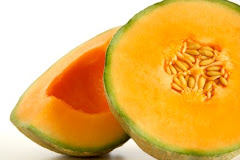
CANTALOUPE/CHARENTAISE MELONS

When are they ripe? When they 'give', a little, at at least one end and a sweet aroma emanates from the outside. Stores will often mark them 'ripe' before this stage, but if they don't 'give' at all, they will probably not be ripe. They may taste pleasant, but will be so much softer and sweeter when ripe. If they give just a tiny bit, in my experience sometimes they will be good and sometimes not.

Cantaloupe and honeydew (and probably Charentaise, but the USDA Nutrient Database doesn't list them) melons are one of the few fruits high in sodium.

Cantaloupes are known as rockmelons in Australia.

For more on cantaloupe-type melons, see my article 'Mellifluous Melons' here.


CHERIMOYA /CUSTARD APPLES

'Custard apple' is the generic term for this sort of fruit. Cherimoya is a variation/hybrid of the custard apple.

I haven't seen the 'bumpy skin' custard apples (as in the pic) in the UK, but supermarkets (eg Tesco and some branches of Waitrose) and ethnic markets often sell cherimoyas in the Autumn (which look a little like the ones in the pic but smoother on the outside).

They tend to be sold hard, to ripen at home, and are ready to eat when they give a little on pressure (and are so delicious - if you haven't tried one, please do!)

To eat, halve, removing the stalk that extends into the fruit. Scoop out flesh-and-pips using spoon, discarding pips. Sounds fiddly, but it IS worth the trouble.

(The 'bumpy skin' custard apples - I last had them in Thailand - have firmer flesh, so can be broken apart with hands, and there's a brown 'pith' that tastes a little like cooked crumble!)


DATES

When soaking, rather than immersing in water, rest in just a little water and cover for a few hours. This will preserve sweetness, flavour and nutrients.


DURIAN

Legend has it that if a tiger is faced with the choice of eating a man or a durian, he'll go for the durian (but I wouldn't put this to the test).

Test of ripeness: the durian should have a definite aroma - wonderful, awful... - reactions vary! If there's no aroma, it's very underripe. If the aroma is very strong, it may be overripe (the flesh inside may be slightly fermented).

Pick up the durian (carefully...) and shake. If there is no movement at all inside, it's underripe. I've eaten durians where there hasn't been movement, and they've been...OK, quite good, but not the amazing experience they can be when the flesh is very soft and very sweet. If there's a little movement, it's just right.

Durian is a climacteric fruit, that is, it ripens off the tree. If you're not sure whether the durian is quite ripe, might be worth leaving it a few days in the sun. If it gets to the points where it starts to split open a little of its own accord, it's definitely ripe. But, be careful. If the distinctive smell becomes a strong stench, then it could be over-ripe and the flesh may be a little brown and fermented.


GRAPEFRUIT

Voted raw fooders' least favourite fruit in international poll gi2mraw.com. Aaah....


HONEYDEW MELONS

Unlike canteloupe and charentaise, honeydew melons can be hard on the outside when ripe (although there are different types - some soften). Shake the melon. If you can hear a faint knock/rattle that means the seeds are loose and it's (probably...) ripe.

For more on honeydew melons, see my aricle 'Mellifluous Mellons', here.


LEMONS

Vary tremendously, in size and juiciness! Be careful with recipes that say 'juice of half a lemon' rather than giving the quantity in tablespoonsfuls. A small not-very-juicy lemon may yield 1-2 tablespoonfuls. But a large, juicy one can give six!

LIME

Ripe limes are yellow, not green, so buy the palest ones you can find, as they'll be the juiciest.

Limes need to be refrigerated, as kept at room temperature the outsides will go rock-hard after a day or two, due to the low oil content of the peel as compared with that of other citrus fruits.


MANGO

Lakeland.com sell a device for cutting mangos, and..it's actually rather good! It neatly bypasses the stone, cutting two 'cheeks' and a central section.

For mango cubes, make a 'mango porcupine'. Take a cheek and score through, criss-crossing. Then turn the cheek inside out and, voila...cubes!


ORANGE

Most of the calcium is in the white pith.


PAPAYA

David Wolfe believes fiery papaya seeds are good to eat as they 'burn out parasites'. Natural Hygiene on the other hand tells us that the taste indicates 'not fit for human consumption' and that the seeds are in fact toxic. So take your pick.

Ripe papayas can be various colours, but the small ones generally sold in the UK are yellowy-orange when ripe. They may still be ripe with some green on but, if there's a lot of green, best to leave them a few days, by the window, until they soften and change colour. Most will ripen; be patient. I have had large papayas that have been ripe when green.

Some people dislike papayas, and, if you're one of them, please give them another chance. Strangely, the ripe papayas I had once in Thailand did not taste good at all - slightly unpleasant even. But all the ripe papayas I've had in the UK, of whatever size, have been delicious. There is a 'distinctive' smell that some find unpleasant. I've been informed by a grower of various type of papaya that this is nothing to do with freshness, as some claim, but simply to do with the type of papaya - some have the smell, some don't.


PERSIMMONS

The persimmon family includes various fruit, including the 'chocolate sapodilla' that I have heard wonderful tales of but have never had the pleasure of trying.

Varieties available in the UK include: kaki (large persimmons), 'large persimmons' (that aren't kaki), and sharon fruit.

Some people think persimmons taste bitter. There is apparently one variety that doesn't taste good, but I've met more than one person who claimed not to like persimmons but was then converted on trying a ripe (sweet) one. They're often sold hard in the shops, but should soften and be ready to eat after a few days.

If your persimmons are stubbornly refusing to soften, try this: apply gentle pressure to the persimmon with the pad of your thumb until you feel it soften underneath. Work all round the persimmon, 'massaging' it until it feels like an over-ripe tomato. It's then ready to eat! (I discovered this by accident after waiting, it seemed, forever, for a batch of sharon fruit to ripen). My 'method' has worked very well to date with organic kaki and non-organic sharon fruit. It didn't work with some non-organic 'large persimmon' from Tesco. If the persimmon doesn't 'give' easily with massage, then leave it a few more days.


PINEAPPLE

Pineapples are not (usually) ripe unless there is at least some gold/brown colouring, the base is fragrant, AND the centre leaves pull out easily. I found this out after purchasing a pineapple from Waitrose labelled 'perfectly ripe' and experiencing a burning sensation on the tongue. So, don't trust what the label says. Always apply the 'leaf' test. If in doubt, don't buy, and don't assume that it will ripen if left for a few days, as pineapples are 'non climacteric', meaning that they don't ripen once picked.

Pineapples were so named because the sailors who 'discovered' them thought they looked like pine cones.


WATERMELON

The best watermelons have red (sometimes yellow) flesh, and black seeds. Avoid pale pink anemic-looking ones with few/no seeds - they're generally lacking in flavour. When is a watermelon ripe? When it can be tapped and gives a 'hollow' sound (although not easy to know what 'hollow' is when all the watermelons on the shelf sound the same.... )Also look for a large yellow patch which is said to show that the melon's been resting on the earth for a long time....

And you'll know it's ripe if it virtually falls apart on the first cut of the knife. If you have to cut right through to separate the halves, it's not ripe. It might taste 'OK', but nowhere near as amazing as it could taste.

For more on watermelons (and more tests of ripeness) see my article 'Mellifluous Melons', here.

___________________________________________________

Are you a fruit-lover? Fancy coming to an all-you-can-eat durian party, where you can listen to Dr Doug Graham and Prof Rozi Graham speak, and meet lots of other raw fooders (even me)?

Check out the 80/10/10 Winter Solstice Party Sat Dec 20th, Sussex, UK at www.foodnsport.com