Tuesday, 30 June 2009

Herbs - Yea Or Nay? Pt 1 - Herbal Medicine

My garden's full of herbs. I love to crush them between my fingers to smell the gorgeous fragrances, revel in the wafts of thyme and rosemary in the air whenever the temperature exceeds 25 C (OK - not often here!), and one of my favourite places to go is the herb farm nearby - it calms me simply to wander round, even if I'm not buying anything. Sometimes I just visit to see if there's a herb I haven't 'got' yet, plant it anywhere, hope for the best, and...usually it thrives, as herbs are generally very forgiving.


I've had a love affair with herbs all my adult life. I went to the Greek island Spetses on the strength of John Fowles' descriptions in 'The Magus' of the wild herbs on the hills. (Interestingly, the Greek island tavernas usually use commercially-dried oregano when the fresh grows wild by the roadside!).

However, my relationship with herbs has changed a little since raw (as do many relationships!). It got distinctly wobbly at first, there was even a short separation, but after a tentative reuniting, and some thrashing out of issues, we reached 'agreement', and now the relationship is different. Just as good, but on a different footing.

I'll tell you how the 'wobbles' started:


Herbal Medicine

A few years ago I was considering studying for a BSc in Herbal Medicine, but got diverted by some 'raw food thing' :-) And, for some months, my passion for raw overlapped with my studies of herbal medicine.

Whilst taking care not to eat food that had been damaged by heat, to preserve nutrients so that everything present in the natural food would still be in correct proportions as it entered my body, there I was attending herbal medicine workshops, where I was being taught how to make 'decoctions', which basically meant boiling the herbs, then simmering for half an hour or so.

On the one hand, I was impressed by statements of the sort made by Anne McIntyre in 'Top Herbal Remedies', which described one of the benefits of using herbal as opposed to conventional medicine as 'using the whole plant'. Anne is critical of scientists who extract components from plants on the basis that they seem to play some beneficial role within the plant, then put them into 'medicines', devoid of the other substances that had surrounded them whilst in the plant, thus making a substance that is not 'the whole plant' and will be toxic to the body, resulting in all sorts of symptoms, described as 'side-effects'.

Well, that made lots of sense to me (and it still does), but, if that's true, I reasoned, then why did herbalists take a natural substance, boil and simmer it, destroying and/or damaging all sorts of things in it, some of which scientists know about, some of which scientists may well not know about, so that the result cannot in any shape or form be called 'the whole plant'?!

The effect of the cooking (based on what we know about the effects of cooking) would likely create toxic by-products, but, at best, would result in a damaged and unnatural substance. And people then put this into their bodies in a belief that it would 'cure'? I put this to the leaders of my workshops and got the impression that they were a bit 'thrown', that is, they weren't used to the question and, as they were on cooked-food diets themselves, had probably never questioned the logic of what they were doing to the plants.

Whether heated and/or processed (eg powdered), or made with 'extracts', many if not most herbal medicines will be far from 'natural' substances.

Little did I know then that I was a Natural Hygienist in the making long before I'd heard of the term Natural Hygiene. As, my puzzles over herbs as used by my teachers were right in line with the NH view of herbal medicine.

NH (and many 'alternative medicine' practitioners) sees acute dis-ease (symptoms) as the manifestation of the body's attempts to heal itself, by eliminating toxins via various orifices - for example, the nose (eg colds), mouth (eg colds, coughs, vomiting), rectum (eg diarrhoea), skin (eg rashes), etc. And, if the body is prevented from eliminating toxins, if symptoms (of healing) are suppressed, toxins will stay in the body, to accumulate and damage organs and tissues, resulting in chronic, severe (and sometimes irreversible) illness.

NH sees herbal medicines as toxic. And, if we introduce a toxic substance into our bodies, there may well be a cessation of symptoms. And that's why all medicines, including herbal medicines, are claimed to 'work', and that's why medicine has had such a hold on human beings for the last few thousand years.

NH explains that symptoms cease because the body's efforts to eliminate existing toxins (manifested in the disease being 'treated') are put on hold while it diverts its energies to cope with the new invader. There may, additionally or alternatively, be new symptoms - for example, vomiting, diarrhoea, fever, sweating, increased urination. Those who believe herbal medicines 'cure' call this 'purging', saying that the herb is causing the body to clean itself out. NH says this is simply the body's going to great, often dramatic, efforts, to try to expel the medicine itself.

Any 'cures' are a cessation of symptoms only, giving the illusion of a cure. If the herbal medicine squashes the body's efforts to eliminate, at some point a new set of symptoms will occur elsewhere as the body will seek another outlet for elimination (we know that many herbal preparations result in 'side-effects' just as conventional medicines do) and/or the accumulation of toxins that the body does not manage to eliminate will cause serious problems. The medicines do nothing to tackle the underlying causes of disease, the apparent 'cure', sadly, diverting people from addressing those causes. Human beings in pain are of course attracted to anything that will stop the pain. But all medicine is simply a 'quick-fix', bringing its own problems, setting the sufferer on a downward spiral. Short-term gain at the expense of long-term pain.

(Some of you may be familiar with the 1930 experiments of Kouchakoff in Switzerland, in which it was found that, after eating a cooked meal, white blood cells rushed (leukocytosis) toward the digestive tract, indicating that the body was fighting what it perceived as an unwelcome substance. This did not occur with raw food. Dr Kouchakoff conducted over 300 experiments and found that all the following resulted in leukocytosis: cooked food, pharmaceutical or recreational drugs, nutritional supplements, processed, refined foods, homogenised foods, chemical foods, and...medicinal herbs.)

NH'ist Herbert W Shelton says that, ironically, the herbs thought to have the greatest medicinal qualities will by definition be the most poisonous ones. He states: 'If an herbal substance does not occasion actions of expulsion and resistance when taken into the body or applied to it, it is not vested with any power to cure. If the body ejects the herb by vomiting, diarrhoea, diuresis, or diaphoresis, and this is accompanied by some pain and discomfort, then the herb is regarded as beneficial and it is used to 'work'. If the patient then recovers in spite of the herb taking, full credit for recovery is given to the poisonous plant, and the self-healing power of the body is completely ignored.'

I'd disagree with Shelton that only those herbs that result in dramatic effects are seen as medicinal. Many 'milder' concoctions are said to have medicinal properties.

Here's Natural Hygienist Mike Benton, writing in the Eighies about the effects of peppermint tea (which incidentally needs a fair amount of peppermint to deliver its 'effects', which is why mint teas are usually made with dried or powdered mint):

'Let's take a simple case where an herb appears to do some work. Peppermint, a rather mild herb by most standards, is sometimes used to 'cure' a headache by herbalists. Your head hurts, so you drink a cup of peppermint tea. Your head stops hurting. Did the peppermint work?

Yes and no. Most headaches are caused by swelling of the intracranial blood vessels around the scalp. These blood vessels swell because of toxic matter in the bloodstream and body, and they then press against sensitive nerves. When peppermint is taken, the body recognizes its oils as harmful, circulation is rapidly increased by the body and the heart speeds up. At this point, the body is attempting to eliminate the peppermint toxins as quickly as possible by increasing circulation so elimination can proceed.

The increase in circulation, due to the toxic nature of the peppermint oils, has an effect on the swollen blood vessels in the head. The vessels are dilated so that the circulation can proceed rapidly and the peppermint poison can be eliminated. As a side result, the headache disappears, temporarily.

So is the headache cured, and did the peppermint work? No, the body did all the work. It worked to eliminate a poison, and these efforts also masked the symptom of a toxic body - in this case, the headache.

The cause of the headache - toxicosis - was not removed by the peppermint. The conditions that brought on the toxicosis - poor diet and lifestyle habits - were not improved by the herb. The headache may have disappeared, but the underlying cause remains. This is the case with all herbs - symptoms are depressed by the eliminative actions of the body which are directed toward the herb.'

Natural Hygiene even has something to say about certain plants (whether or not classed as herbs in modern day language) used in their whole, natural form, unheated, topically, such as comfrey or plantain to 'seal' minor wounds. Again, it is that they 'work' only because of their toxicity. If a herb is applied to a cut, yes, it may well 'seal' and stop bleeding, but that is because the body is attempting to protect itself against the toxicity of the herb itself.

When all's said and done, it's worth remembering that, whether we agree with the Natural Hygiene view of herbal medicine or not, an all-raw diet will reduce the need for healing anyway, as it removes many (not all!) of the causes of ill-health from our lifestyles. For example, yes I found chamomile tea very soothing once when I had stomach pains. But, since raw - no stomach pains (OK - bar bad wind once when I ate a watermelon that was 'off'!) When on a cooked diet, I'd found inhaling peppermint suppressed headaches - I assume in the way that peppermint tea 'works' as described by Mike Benton above. But - you've guessed it - no headaches (more than for a few minutes) since raw! (I suspect cutting out tea, coffee and alcohol might have helped though). And, finally, yes, I was very excited once, when on a cooked diet, to find that binding a cut with plantain did stop bleeding very quickly, but have now found, in common with others on 100% raw high-fruit diets, that, at least for minor cuts, the bleeding stops much more quickly than it ever did when cooked! So, no actual need for (short-term) herbal 'remedies' anyway!


So, in line with Natural Hygiene, I do not now advocate the use of herbal medicine any more than I do conventional medicine, which puts me at odds with many in the 'alternative health' world.


I realise that an article that effectively debunks herbal medicine, which has been practised for 'thousands of years' (as has cooking of food, meat-eating, killing each other etc) may not be popular with those who swear by it, but all I can say here is that none of us can be sure we're on the right tracks, but what I've learned seems logical to me.


Herbs and the Essenes


I've often looked to Essene texts for guidance, and the NH line on herbs may conflict with the Essenes, as my sources say the Essenes believed there was 'a herb for every ailment'. However, I'll sidestep that one by saying that, despite hours spent googling this, I've not yet been able to establish exactly how the Essenes used herbs. OK - according to historian Josephus, they 'seeked out medicinal roots for healing'. But, regardless of anything present-day people who call themselves Essene may do, I haven't to date found any evidence to say that the Essenes of two thousand years ago made 'decoctions', that the people who followed the Teacher's advice in the Essene Gospel of Peace to 'cook not', cooked the plants they used for healing.


And it's worth bearing in mind that, thousands of years ago, the word 'herb' was used in a broader sense than today; it was used to describe vegetation in general, rather than one class of (generally aromatic) plants. So it's possible that when the Essenes used the word 'herb' they meant plant foods in general, and were talking about the nutrients in foods that we know can supply our bodies with nutrients that will help our bodies heal. Bu, if you do know of any hard evidence that the Essenes were making potions in the way a modern herbalist might...let me know.


In Part 2 I'll tackle herbs as food/flavourings, and will explain why I do in fact partake of a little sprinkling of oregano on a tomato and cucumber salad, and, how, even for Natural Hygienists who don't use herbal medicine, and choose not to use herbs with food, herbs can still enhance our lives!

Tuesday, 2 June 2009

Why Did T C Fry Die 'So Young'?

For those of you who aren't acquainted with Natural Hygiene, it can be summed up in a few words: 'leave the body alone.'

Provided we live healthfully, we will remain healthy. When we don't live healthfully, there are consequences. All illness has a cause or causes. Natural Hygiene says that when illness occurs we should remove the causes of illness (unhealthful living), obtain sufficient rest and sleep to allow the body to muster sufficient energy to heal, and re-establish the conditions for health.

Natural Hygienists take a somewhat radical view of medicine. They do not put medicines (even herbal medicine) into the body, on the basis that medicine is toxic, only palliates symptoms, simply appearing to 'cure' by temporarily diverting the body from symptoms resulting from its attempt to clean itself of toxins.

Neither do they have 'treatments', as 'any alien substance introduced into the body interferes with body functions, thus destroying or pathologically modifying them.'

The Natural Hygienist who said this was T C Fry, responsible for a huge resurgence of interest in NH from the Eighties onwards, and at least partly responsible for my own interest. I thank him for my being able to study a treasury of instruction materials he put together some 30 years ago, featuring articles from various eminent Natural Hygienists, including the 'father' of Natural Hygiene - at least from the last century onwards - Herbert Shelton.

T C Fry stressed that Natural Hygiene was not just about diet. Amongst the other essential factors of life he lists in Part 1 of the 'Life Sciences' instruction materials are: emotional equilibrium, rest and sleep.

TC's message was clear. Keep the laws of Natural Hygiene and a long, healthy life will be ours.

Then he died.

Aged 69.

In very poor health.

TC's death was a crushing blow to the movement, leaving many followers (as in so many things people do have a tendency to follow the man rather than the message...) disappointed, disillusioned, and confused. It also left Natural Hygiene a soft target for those who had always opposed its basic dietary precepts - a diet high in fruit (with vegetables, nuts and seeds) and free of supplementation.

All Natural Hygiene students come across this at some point in their research and...it's a bit of a 'spanner in the works'. We're reading material that we know makes sense, we see TC's the author of some of it, but...hmm...what happened there?

In an attempt to reconcile this myself, and to help the many who I've seen enquire about this over the years, I've been collecting data about 'TC' , or 'Terry' to his friends. (EDIT April 11 - Some people think that TC' actually stood for 'Thunder Cloud' named after his Cherokee Indian grandmother. However, I am very grateful to Vian, TC's daughter, for informing me that 'TC' came from his father's initials - 'Tony Carnell Fry', although TC's great-grandmother was indeed half Cherokee Indian.)

After reading Dr Virginia Vetrano's book 'Errors in Hygiene?!!?', I decided to summarise here what I've found out from various sources. Much of the information here is extracted from, or a paraphrase of, material in Dr Vetrano's book, but I've also included information from Chet Day's article 'Life and Times of T C Fry', Dr Doug Graham (author of '80/10/10 Diet') - many thanks to these three - and other published and internet sources, together with my own commentary.

Hopefully, this article will make things a little clearer to those who have wondered, and also provide information to supply to those who like to ignore the hundreds of thousands of people who have transformed their health with Natural Hygiene and are thriving in old age, instead swooping on the slightly-earlier-than-average death of one man, drawing conclusions on the basis of little data, and using them as ammunition to discredit an entire movement.

I do realise that there may be some reading who knew TC, so, if anything is factually incorrect, or you think I've drawn incorrect conclusions and/or made unfair inferences, just let me know privately, and I'll consider editing. (Edit! I've altered the article a little since original publication following information/comments from people who knew TC - thank you!)


TC 'BEFORE'

TC came to Natural Hygiene at the age of 45.

He was: overweight, had gastric problems, a heart condition, may have had a lung condition (an X-ray at autopsy showed a previous collapse of a lung) and had very poor teeth (gum disease, multiple abscesses and bone degeneration).

Reports conflict as to whether he had been a smoker (autopsy showed lymph nodes containing carbon and scar tissue - common in those who have smoked at one time).

There are also isolated reports of his having been stabbed whilst working as a detective in New York and injured fighting in WWII. However, as he would have been only 15 when the war finished this seems unlikely.

Whatever the case, it's fair to say, that, health-wise, he was...in a state. Dr Doug describes him as 'at death's doorstep' and says of TC 'At the age of 45, with his health failing terribly due to an intensively abusive lifestyle characterized by its excessiveness, he turned his life around. The doctors had already told him that he didn't have much longer to live. A change in diet coupled with attention to many of the other necessities of healthful living gave Terry another twenty-five years.'

When we consider this, it does put TC's relatively early death into a new light. His very poor health led him to Natural Hygiene, and the effect of NH on his health was so dramatic that it provided the impetus to devote the rest of his life to promoting its principles.

However..., I'm going to suggest (and I'm not the only one to) that he could nevertheless have lived for longer, and suffered less, if he had been paying a bit more attention to those 'other necessities of healthful living', as will be explained.


THE NATURAL HYGIENE YEARS

Further damage to T C Fry's body

TC had a somewhat 'colourful' private and business life. Dr Vetrano's book describes many examples of this, but one notable is that of a business row with a former lover which resulted in her shooting him in the back of the head at close range.

This not only had an obvious immediate effect on his health, but took a long-term toll, in that he experienced black-outs for some time. Shortly after he was told it was safe to drive again, he had a serious car crash that crushed his chest, broke many ribs, and damaged his lungs. Peter Gregonis describes how TC (or as Gregonis describes him, 'Tough Cookie') discharged himself from hospital immediately and that 'for 14 days TC refused food in order to give his body a chance to concentrate all of its energy upon the healing process. The healing process took less than a month; it would have taken twice as long under hospital care.' However, I'd comment that the fact that TC was back working so quickly after such a serious accident may also, unfortunately, have given rise to a false sense of 'indestructibility' that could have adversely influenced his lifestyle in later years.

Poor diet previous to NH had resulted in damage to the teeth. TC did not have repair work done and over the years he was subjected to much pain and fever due to bacterial toxins from abcesses. This would have been enervating and would have resulted in much toxicity in the body (septicaemia).

So, we have a man who was already in a bad state healthwise before discovering Natural Hygiene then receive a bullet in the back of the head, followed by chest and lung injuries, and septicaemia. Any body would have had its work cut out attempting to heal itself from such a huge amount of abuse and damage.

Was TC following Natural Hygiene principles of healthful living?

Let's look at whether TC implemented the diet, and had the emotional equilibrium, rest and sleep necessary for his health to improve.

Firstly, we have to assume that at least initially he must have been following the Natural Hygienic lifestyle sufficiently to result in amazing improvements, as nothing else could account for his zeal and devotion in spreading the Natural Hygiene message.

But, ironically, in spreading the message, his lifestyle became one in which certain areas of healthful living were neglected.

Diet?

Not many of us, whether all-raw or not, are perfect in our eating, and I understand the feelings of those who feel that its unfair to criticise TC for deviations from the ideal. However, as TC's death has been used by some to discredit the Natural Hygiene and the 'fruitarian' diet (however that is defined), and even to sell supplements, what he actually ate, and the way he ate, is of great relevance.

Early in his Natural Hygiene years, accounts suggest TC was fairly strict about his eating. And it sounds as if most of the time TC's diet was 'Natural Hygiene'. But the areas in which it was not are worth noting.

Chet Day and others cite reports saying that TC would frequently eat nothing in the day then 'binge-eat' in the evening, often continuing to eat late into the night, on very large meals that mixed all sorts of fruits, vegetables and nuts. An acquaintance of Day's said that 'the next day he [TC] would have gastric distress and blame it on the nuts.'

Natural Hygiene warns us to be careful not to combine foods that are 'digestively incompatible', and eating vast amounts late at night, especially if stressed, (and, as will be explained, TC was - a lot of the time), is a ticket for indigestion. Dr Herbert Shelton: 'The almost universal practice of overeating, of eating at all hours of the day and night, of eating improper food, and of eating wrongly-combined foods...is amongst the causes of chronic gastritis.'

This pattern of eating would surely have exacerbated rather than improved the pre-existing gastric problems TC had at the start of his Natural Hygiene career.

The typical Natural Hygiene diet is high on fruit (sweet and non-sweet) and vegetables, with a small amount of nuts and seeds. Did TC always follow a Natural Hygiene diet? No. For example, there were...transgressions. TC's diet included at times 'shop-bought coleslaw inundated with vinegar and mayonnaise', 'desserts such as ice cream', pie, cake, macaroni, cheese and canned food. It should be noted that TC switched from the standard American diet to 100% NH/raw overnight, rather than in gentle steps. That's a tough call, and his subsequent occasional slips will be understood by those on all sorts of raw food diets. Also, he had not come to NH via a cooked vegan diet, so, as a close friend comments, 'it is understandable that when he relapsed, he went back to what he knew.' However, sadly, his departures from the NH diet included exactly the sorts of foods that would exacerbate 'heart problems' (present when he embarked on NH) and may well have reversed to some extent the spectacular gains in health he had made when first discovering NH.

And it must be said that TC didn't actually teach or follow the traditional Natural Hygiene diet. TC advocated a diet of all, or almost all, sweet fruit, and had decided that nuts were not a part of a healthy diet, contrary to the teachings of his mentor Herbert Shelton (see article here).

Emotional equilibrium?

Constant financial problems meant that TC was under considerable stress; there were frequent run-ins with the IRS. Several times all his business possessions were confiscated. Health writer Ric Lambert: 'Terry...was under unrelenting stress and never got out of one legal battle or confrontation before he was engaged in a new one...'

Rest?

As has been explained, when TC came to Natural Hygiene, his health was in a very poor state. And the head injuries from the bullet, and the chest and lung injuries from the car crash after that necessitated an extended period of rest to allow the body to heal.

Unfortunately, TC was a workaholic who would not rest. All accounts suggest TC was working harder than ever following these traumas to the body rather than resting. So, sadly, whilst spreading the word about Natural Hygiene and improving the health of others, his own health deteriorated rather than improved.

Sleep?

Dr Vetrano records that TC slept very little, often getting up in the middle of the night to work. He would rise at 4 am feeling 'groggy' , and go for a run to wake himself up, that is, in Vetrano's view, 'he used exercise as a stimulant'. Of course the combination of chronic gastroenteritis with eating large amounts of food at night is not conducive to sleep. In short, TC Fry could not have obtained the recuperative sleep necessary for a body damaged by abuse pre-Natural Hygiene and further damaged by events post-Natural Hygiene to heal, let alone support a stressful lifestyle. He must have been seriously enervated.


THE DECLINE...

Perhaps if, on discovering Natural Hygiene, TC had just lived quietly, following its principles, his body would have had a chance not just to recover a little, but to truly heal from the first 45 years of unhealthy living followed by the additional traumas to his body. Perhaps if he had been able to retire and live a simple life, he would still be with us now.

However, the health improvements he had experienced when first embarking on Natural Hygiene drove him very,very hard to communicate its principles to others. Unhelpful eating patterns, stress, lack of rest and sleep would have constantly depleted his energy, meaning that his body not only had none left to attempt to heal pre-existing conditions and the further injuries, but would of course struggle to eliminate any more toxins that came his way. I'm going to hazard a guess that the unhealthful foods TC is reported to have eaten at times would most likely have been turned to at times when he was most busy and/or stressed, and the problem there is that processed sugary foods deplete the body of vital B vitamins it needs for a healthy nervous system, and needs so very much when we are stressed.

At various times in the few years before his death TC appeared short of breath. Dr Vetrano says he had 'chronic lung problems' for at least five years before his death. Natural Hygienist Dr Ralph Cinque reported that TC had swollen ankles (oedema), with the suggestion that these could have been due to TC's pre-existing heart condition. And TC continued to suffer from digestive problems. Dr Vetrano reports he suffered from 'bloating and flatulence with practically every meal.'


THE YEAR PRECEDING TC'S DEATH

In the spring of 96, six months before his death, TC was so weak and sick that he could barely walk, and had difficulty breathing. His legs were swollen and he was pale. He frequently had a low-grade fever. According to Dr Ralph Cinque, he was too weak and emaciated to fast.

Natural Hygiene says that what TC should have done at this stage was to remove the conditions for ill-health, rest to allow the body to heal, and re-establish conditions for good health.

TC's 'mission' (and, most likely, financial considerations) persuaded him that he could not stop work, save for a short break at a retreat, which, despite the owner's requests for the sake of his health, he would not extend as he was determined to complete Herbert Shelton's dream of setting up a Natural Hygiene college. Natural Hygiene would also say that at this time, more than ever, a diet of raw fruit, vegetables, nuts and seeds would be essential. However, in this period, TC was eating cooked food.

So, at a time when he needed to follow the principles of Natural Hygiene most, he did not.

Neither did he seek conventional medical treatment, which at this point in his life some would argue might have been justified from a 'crisis management' point of view.

He instead resorted to 'ozone therapy', an unnatural treatment which is in complete opposition to the principles of Natural Hygiene. He told Dr Vetrano that he felt 'very ill' after having ozone treatments, and that he had been 'talked into' having them.

We can all imagine how, if we are feeling weak, in pain, unable to breathe properly, scared...how we might consider anything anyone suggests might help. But it's such a pity that the more ill TC became through not following the principles of Natural Hygiene, the more he lost confidence and the more he departed from them - truly a vicious circle.

TC had 17 ozone treatments in the year before his death, and Dr Vetrano is convinced the 'debilitating' treatments hastened the progression of pre-existing degenerative conditions and resulted in much damage to his lungs from the free radicals generated by the ozone. Much of her book is devoted to explaining in detail why she feels that the exhausted T C might still have recovered were it not for these treatments. She describes them as the 'coup de grace that killed him.'


EVENTS AT DEATH

Shortly before death, TC had oedema, 'moderate to severe' atherosclerosis, emphysema, lesions in his lungs and difficulties breathing, bronchitis, pneumonia, gastritis, gingivitis, and no teeth.

The cause of death, as recorded on the death certificate, was 'Pulmonary embolus probably caused by deep venous thrombosis.' Vetrano is firmly of the opinion that the thrombus was actually in the lungs, and, again, believes the ozone treatments to be the underlying cause of this. She also blames the treatments for damage found to the heart at autopsy.

TC also had anaemia due to B12 deficiency. Now, there are differing views here as to what contribution this made to TC's demise and why the deficiency. Contrary to the hospital records 'cause of death' as reported by Dr Vetrano, and contrary to Vetrano's own views of the cause of death, Joel Fuhrmann MD believes B12 deficiency to have been the cause and that the deficiency was due to the fact that he did not supplement his diet with B12. (My problem with this is that we are told that TC did on occasions eat processed foods containing eggs and dairy, which would have contained B12.)

Dr Vetrano disagrees that raw vegans need supplementation (and, as noted, TC wasn't quite raw vegan anyway) and believes that the deficiency was due to TC's gastroenteritis. She takes the controversial view that we can obtain B12 for our (very) small needs from foods with B vitamins generally (the amount of B12 present so small that it cannot be measured) and also that B12 can be formed by bacteria in the small intestine (see Dr Gina Shaw's article here on this.) However, she says that TC's chronic gastritis would have prevented him from secreting sufficient 'intrinsic factor' to absorb it.

I will also mention Dr Vetrano's views on TC's diet, as this forms a significant part of the last section of her book, and it's only right to give space to her views here, as her book yielded so much material for this article.

Dr V believes that TC's problems were partly due to the lack of 'concentrated proteins' (nuts and seeds) in his diet. She believes that TC, due to his weakened constitution and stressful lifestyle, needed more protein than the average, and that a diet of fruit only did not supply the level of protein he needed for his body to carry out its functions, particularly repair. Consequently, Dr Vetrano believes TC was malnourished, and that this would have contributed to all his health problems. TC, as we have seen, had problems digesting nuts; it's Dr Vetrano's view that people who believe they cannot digest nuts can build up by eating them in small quantities, properly combined, for example, with leaves.

Whatever the cause of death as recorded on the death certificate, it can be seen that, whether one agrees with Dr Vetrano's views on diet or not, there was a multiplicity of underlying causes of death, firmly linked to TC's lifestyle.


DID T C FRY DIE AT 69 BECAUSE HE WAS FOLLOWING A NATURAL HYGIENE LIFESTYLE?

NO. HE DIED AT 69 BECAUSE OF A COMBINATION OF DAMAGE TO HIS BODY PRE AND POST DISCOVERING NATURAL HYGIENE AND NOT FOLLOWING A NATURAL HYGIENE LIFESTYLE.


Although it's a shame that TC isn't still spreading the Natural Hygiene message in his 80s, as did/do other well-known Natural Hygienists such as Herbert Shelton, Virginia Vetrano and Keki R Sidhwa, TC's life, and death, are an example of the laws of Natural Hygiene in action - a vindication of Natural Hygiene.

It could be argued that his life was a sacrifice - a splendid example of what happens when we ignore key factors necessary for health.

TC spread the teachings of Shelton and others, and directly and indirectly improved the health of so many. He was mentor to Dr Doug Graham and, I'm sure, many Natural Hygienists. And, for whatever part TC played in motivating Doug in his career, I am grateful.

Dr Doug: 'his intensity got the better of him. He simply worked himself to death in an effort to spread the health message to as many people as possible.'

Dr Vetrano: 'Unfortunately, people in great places, who do great things, seem to be the very first ones who are taken first, simply because they are programmed so strongly to achieve their goals that they forget 'self', and even the principles they espouse.'


WHAT CAN WE LEARN?

The story of T C Fry reminds us just how important it is to attend to the non-diet factors that can affect our health. Those educating others in health (and, really, that includes all of you reading, unless you never talk to others about your lifestyle) have a responsibility to practise what we preach. We must work hard (as it were...) to reduce stress, and get sufficient rest and sleep. And, by that, I mean 'lying outside in the sun for 30 minutes doing nothing' should be on our 'to-do' lists - that's as much part of our jobs just as surely as finishing that article or preparing that demo!

And, if we do neglect certain factors necessary for optimum health, we should come clean on these. In that way, we can still make a great and positive difference to the world, and as long as we have made it clear in which ways we do not live healthfully, if we do then become ill, the risk of disappointment and confusion to those who have listened to our pronouncements will be minimised (BTW, just so you know, I spend far too long tapping away in this room, pig out sometimes on unwise combinations of food, then experience gastric 'disturbances', and often abuse my stomach by binge-eating vast quantities of banana-date smoothie until it hurts. But am trying to improve.)

If we live a healthy lifestyle most of the time, but fail sometimes, for example, by eating unhealthy foods, and lapse on non-diet factors necessary for health, we must be aware that there will likely be some sort of price to be paid. It's a mistake to think of ourselves as supermen/women just because we eat raw, run marathons, whatever, who can't possibly get ill no matter what we do, particularly if our bodies are a little weaker than average due to abuse in a 'previous life' of unhealthful living.

No matter how much we try to control various aspects of our lives, there will always be toxic elements in it beyond our control - for example, in the air we breathe! If we ensure that we score highly on non-diet health factors, such as sufficient sunshine, fresh air, rest and sleep, we should be able to maintain sufficient energy to eliminate these toxins as they come along without any serious symptoms. But if we are so driven in one aspect of our lives (for example - our careers, however world-serving they are) that we ignore those factors, and particularly if we become stressed, our energy will be so reduced that we may succumb to illness - however good our diets.

TC's life, and early death, is a vital chapter in the history of Natural Hygiene, and a salutary lesson to us all. If a little-known Natural Hygienist had lived as TC had, and died in the way TC did, we wouldn't have heard about it. I'm so grateful to TC for the work promoting Natural Hygiene that he did do in his short life. I've seen photo's of him - an intense-looking 'life of the party' sort of man with bushy eyebrows - I wish I'd met him! I'm also grateful that he was such a larger-than-life and high-profile character that we have the story of his life to remind us that no matter how brilliantly we communicate the principles of healthful living to others, we have to implement them in our own life if a) we want a long and healthy life and b) we wish to become a beacon of health.

We may not start a health school, or write a best-seller, but let's increase the chances of our being a living testimony to our lifestyle at 100 rather than checking out at 69 and giving our detractors a field day.

Wednesday, 20 May 2009

Where do you get your...iron?

Iron is an essential component of haemoglobin (Hb). Hb is the substance that makes our blood red, and transports oxygen to all parts of the body. Two-thirds of the body's iron is contained in the Hb, with the remainder stored in the liver, spleen and bone-marrow.

Insufficient Hb, resulting in insufficient oxygen supply to the body, and generally known as anaemia, can cause all sorts of problems, but the most well-known manifestations of deficiency are tiredness, breathlessness and headaches.


HOW MUCH IRON DO WE NEED?

The RNI (Reference Nutrient Intake) for adults is 8.7 mg daily average. For menstruating women it's set at 14.8 mg. But...bear in mind that figure is set with the average woman (on a standard cooked diet) in mind. It will not apply to the majority of all-raw women, who generally bleed far less than the average (see my article on menstruation here).

Can iron be stored?

Yes, which means that we don't need to concern ourselves with iron intake within any one day - it's the intake over a period of days, or weeks, or months, that counts.

Can we have too much iron?

Yes. High levels of iron in the blood have been linked with cancer and heart attacks. And high doses of iron supplements have been linked with constipation, vomiting and diarrhoea, and can be fatal.


RAW VEGAN SOURCES OF IRON

The following raw vegan food groups tend to be particularly high in iron: seeds, nuts, dried fruit, dark green leaves.

Here are just a few examples of foods high in iron, and I've been realistic on serving sizes. For example, you will often hear people say that parsley is high in iron. Well, yes it is, per 100g. But parsley is so light in weight that you'd have to eat five packs for it to make it onto the list below.

Pumpkin seeds, 1/2 cup, 10 mg iron
Dried apricots/peaches, 100g, 6 mg
Cashews, 1/2 cup, 5 mg
Pine kernels, 1/2 cup, 4 mg
Sunflower seeds, 1/2 cup, 4 mg
Almonds, 1/2 cup, 3 mg
Spinach, 100g, 3 mg
Sea veg (generally), 100g, 2-3 mg
Kale, 100g, 2 mg
Walnuts, 1/2 cup, 2 mg
Sprouted lentils, 1/2 cup, 2 mg
(Source: USDA Nutrient Database)

Raw fooders who eat at least some of the foods on this list regularly should have no problem in making the RNI of 8 grams, as most of the other foods eaten in a week will also be contributing to iron requirements.

High fruit diets

Fresh fruits highest in iron are berries (eg raspberries, blackberries) at 1 mg per 100g. Fruits such as bananas, mangoes, papayas and tomatoes contain on average 0.3 mg per fruit. But I know people who eat a lot of bananas! 10 bananas would give 3 mg of iron, and therefore be a significant source of iron. I have a passion for persimmons (0.6 mg) and could easily eat several. Five persimmons would yield 3 mg of iron.

So those who follow high-fruit diets, who have fruit in quantity, as 'meals', should have no problems obtaining all the iron they need, even if they eat very little of the foods in the 'high iron' list.

And, as Vitamin C helps iron absorption, high-fruit diets win all round (and, incidentally, the fact that raw fooders in general eat more Vitamin C counterbalances the claim from some that iron from animal foods is more easily absorbed than that from vegan sources).

(note - dried fruits are often said to be good for iron. Any dried food will 'appear' to score highly on nutrients, but that's simply because the water's been removed and therefore there will be more fruits per 100g, therefore more nutrients per 100g. As 'more nutrients' here is somewhat of an illusion, and dried fruit can bring its own problems, eg teeth problems, best to stick to fresh wherever possible.)

Iron antinutrients

I did start off with quite a long list of substances that some believe interfere with iron absorption. But there are so many contradictory studies that, in most cases, it wouldn't be fair to point the finger.

So, I'll stick with the 'perennials', about which there is no disagreement. They are:

Tea (including herbal tea - it's the tannins...)
Coffee

(especially when drunk with meals)


ARE 'ALL (100%)-RAW FOODERS' LIKELY TO SUFFER FROM IRON DEFICIENCY?
I believe not, for the following reasons:

Foods typically eaten by a raw fooder over a week will contain several on the 'high-iron' list, with many other contributing foods. And those on high-fruit diets eating fewer of those foods will be eating fruit in such large quantities that iron requirements should be met easily. (I analysed my own high-fruit diet using Cronometer, and I'd exceeded the daily iron RNI.)

The raw fooder's diet will be high in Vitamin C, found in fresh fruit and vegetables, maximising the chances of iron ingested being absorbed.


Women of child-bearing age eating raw will generally bleed far less (and thus lose less iron) than women on standard cooked diets.

(Raw fooders may well have lower Hb counts than meat-eaters, but...see below.)

ARE 'HIGH RAW FOODERS' LIKELY TO SUFFER FROM IRON DEFICIENCY?

I'd suggest not likely, but there would be more reason for a high raw fooder than an all-raw fooder to be low on iron. The good news is that high raw fooders concerned about iron have lots of opportunies to improve their diets so that more iron is ingested and/or absorbed.

But, first, let's look at 'low on iron' more closely.

A common scenario: the happy little raw fooder, feeling hale and hearty, has a 'routine' blood test and is told they are 'low on iron'. The mouth turns down...and of course stress isn't good for health!

Iron can be measured in various ways, but the most common is the Hb count (haemoglobin concentration). In broad terms, 14 gm/dl of blood ('dl' = decilitre = 1/10 litre = 100 ml) is said to be 'average', less than 12 gm/dl is said to be 'low', and below 10 gm/dl 'anaemic'. However, I'd suggest that if iron is just a little lower than the average and there are no symptoms of deficiency, then there is probably nothing to be concerned about. Bear in mind that studies as to what is an optimum iron level will have been carried out on the population in general, which of course includes meat-eaters. Iron may well be higher in meat-eaters, but that doesn't necessarily equal good. What's 'normal' is not necessarily healthy.

For the 20 years preceding raw, I followed a cooked meat-less diet. As a blood donor several times I was told I couldn't donate due to 'low iron'. However, in all those years I had more energy and was healthier than most people I knew, and had no iron deficiency symptoms. Those who do feel 'tired'...this could be due to so many things. People who are neglecting their health in various ways, eg through overwork, not enough sleep, not enough fresh air, negative thinking...can easily feel tired. As raw fooders are more knowledgeable about nutrition than the average, it's tempting to look for the answer to problems in what we're eating, but we should also remember that as raw fooders our very good diets are the least likely to be responsible.

And some studies are suggesting that 'low' blood iron may not be such a bad thing...Cancer Prevention Research Trust UK: 'low blood iron helps protect you from cancer as well as from bacterial infections.' 'The greater the iron concentration in a person's blood, the greater risk of developing cancer', says epidemiologist Richard Stevens of the Pacific Northwest Laboratory in Richmond, Wash, US.

Here's a little more on iron and whether 'normal' is healthy, from my article on health reasons for not eating meat:

John Robbins discusses meat and iron in his book 'Healthy at 100'. Paraphrasing the information in pp149-51, for many people one of the 'health' reasons they might give for eating meat is the iron in it. The iron in meat is called 'heme iron', and the iron found in plant foods is 'nonheme' iron. 'Heme iron' is certainly more easily absorbed by our bodies than nonheme iron and some people have taken this to mean that, because of this, nonheme iron is in some way inferior to heme iron. But excess iron poses dangers to health. Antioxidants are deservedly recognised for their role in preventing cancer and other illness. But iron is the opposite of an antioxidant; it is a potent oxidant. Excess iron causes the production of free radicals hich can damage cells, leading to disease.

'For example, when sufficient quantities of heme iron are present, as is likely to happen when diets contain appreciable quantities of beef, cholesterol is oxidised into a form that is more readily absorbed by the arteries, leading to increased rates of heart disease. With nonheme iron - the kind found in plants - it's a totally different story. Your body absorbs only what it needs.'

Dr Thomas T Perls (Harvard expert on longevity): 'It's possible that higher iron levels, which may have been considered 'normal' only because they are common in males, actually speed the aging process.' According to Dr Perls, lower iron levels in adults (up to a point, of course) are an advantage and that 'it may turn out that adults, and perhaps even adolescents, are speeding up their aging clocks by maintaining iron levels that are now considered 'normal', but may in fact be excessive.'

However, in the cases where Hb is very low and there are symptoms indicative of too little iron, there are several ways in which iron intake and/or absorption can be increased:

1. Increase consumption of foods particularly high in iron, as per chart above.
2. Increase consumption of fruit (sweet and non-sweet) to increase Vitamin C, which helps iron absorption.
3. Decrease consumption of tea and coffee.
4. For women - increase percentage of raw food, as all-raw women generally have lighter periods, meaning less iron lost, therefore less needs to be ingested.

And...get more sleep (sometimes more easily said than done!).

Dr Ron Cridland, MD, believes that deep sleep is crucial for iron. Dr C , in his lecture 'Energy: The Key to Health.' says that he would test people and find that they were low in iron/anaemic, but that they had normal levels of ferritin. He explained that ferretin is essentially the iron stored in the bones and that during Level 4 sleep (the stage before REM), ferretin is involved in distributing stored iron through the blood. So, with adequate levels of deep sleep his patients would recover without changing their diet or taking a supplement. (Thanks to Nick Sirpo for this.)

Should a supplement be taken?

There are many reasons for looking to food rather than supplementation to increase iron.

Natural Hygienist Dr Virginia Vetrano warns against synthetic iron: '...iron supplements have an irritating effect upon the gastrointestinal mucosa. Anything that affects the mucosa disturbs, interferes with, and impairs normal absorption and selection of natural nutrients.'

Cancer Prevention Research Trust UK Guideline 7: 'Avoid iron tablets and food with added iron.' (Did you know that iron added to food is often simply in the form of iron filings? I'm told that if cereal is put in a plastic bag, mushed up and shaken and a magnet run over it, the iron filings in the cereal will stick to the magnet.)

The taking of mineral supplements, whether synthetic or 'natural', where the mineral is ingested in isolated form rather than in correct proportions with the other minerals and vitamins present in foods, runs the risk of creating all sorts of imbalances. For example, calcium and zinc supplements have been shown to decrease iron absorption. Iron supplements themselves have in high doses been shown to decrease zinc absorption. But, when we eat a whole raw food, we can be sure that the iron in that food is there in just the right amount to work with the other minerals and vitamins in that food.

I found this from Mike Benton, a Natural Hygienist writing in the Eighties, that explains it beautifully: 'The mineral iron that is present in a cherry, for example, is readily absorbed and used by the body because the other necessary elements for the absorption of iron co-exist in the cherry or food itself. For instance, ascorbic acid aids the absorption of iron in the body by helping to convert ferric to ferrous iron. The cherry has the needed ascorbic acid present with the ferric iron compounds. If you swalled a pill that had the iron extracted from the cherry but not the accompanying ascorbic acid, then your body would simply not have the needed co-existing elements to use the iron.'

I'd suggest high-raw people concerned about iron explore every avenue possible in which iron can be increased via food rather than resorting to supplements, the use of which at least in some cases has been shown to be harmful rather than beneficial, and, at least, is controversial. For more on supplements, see my article here.

It was sad to hear someone accusing a nutrition expert recently of preferring to see her in ill-health than have her take a supplement, when he had in fact given her all the steps necessary to increase her iron naturally - steps that would have benefited her health in countless ways had she been willing to implement them.


*****
Postscript Feb '10 - at the time of writing this article I didn't actually know my own iron level. However, I had it checked recently and, although I don't have the exact figure, was told by the doc that it's 'normal' (!).
________________________________________________________

Monday, 4 May 2009

Mellifluous Melons

Mellifluous: 'sweet; as if with honey'.


I've a passion for melons right now, and the shops are beginning to stock some deliciously juicy, and, most importantly, ripe ones!

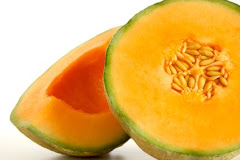
As well as tasting amazing, melons are one of the most healthy fuel sources in that they are simple carbohydrates, that is, they digest quickly and easily, and contains lots of nutrients. For example, the USDA Nutrient Database tells us that a cantaloupe melon scores highly on: Vitamin C (three times RDA), Vitamin A (120% of RDA) and potassium (92% of RDA). It does well on: magnesium (22% ofRDA), Vitamin B1 (16%), Vitamin B3 (26%) and Vitamin B6 (20%). It contains small amounts (5-10% of RDA) of calcium, iron, zinc, Vitamins B2 and B5, and Vitamin E, and also includes 18 amino-acids from which our bodies make protein, and essential fatty acids in trace amounts. (And the 'cantaloupe' and pale-fleshed type melons are also the only fruits I can think of that are relatively high in sodium which make them a good source of sodium for those who prefer not to add salt to their food.)

And that's just cantaloupe! Melon nutritional profiles will vary, for example watermelon is particularly high in lycopene.

Anne Osborne, author of 'Fruitarianism, The Path to Paradise' has spent three periods in her life eating nothing but melon for months! Although her melon diets did include different sorts of melon, she did find that even when she ate one type alone for a while she would 'each day experience a myriad of new taste sensations.' Although conventional nutritionists would issue all sorts of dire warnings about such a diet, Anne says 'During my time on melons, my health and energy levels were always excellent and my weight remained at a stable 112 pounds.' And, on day 47 of a melon diet Anne came first in a walkathon out of 4000 people!

I had (just) a day 'mono-eating' melon exclusively recently. My energy level was high all day (from 4.30 am when I rose, to going to bed after an evening's salsa dancing), my tummy felt wonderfully calm, and it was dead flat throughout.)

Melons are best eaten alone. Of course, they are so delicious that who would dream of detracting from their delicate and beautiful flavour by combining them with other foods? (Well, OK, for those who would, 'food combining' principles for optimal digestion back me up here - melon is so quick to digest that if you mix it with, or eat it shortly after, food that is harder to digest than the melon (which is virtually any food, including most fruit), its exit will be blocked, meaning it will have to hang around, and it will ferment...and...blow-up! So, if you don't want the six months' pregnant look and some pain, eat me-lon a-lone.

But, melons..can get a bit confusing sometimes with all the different types, and it's so disappointing to come home and find you've got a dud one - one that's so unripe we hurt our hands trying to get a spoon into it it's that hard, and find the outer half of it so lacking in sweetness it might as well be a cucumber, or a squash. Melons, officially, do not ripen off the plant - they're non-climacteric. Some people do maintain that they improve after a few days, but this is basically softening due to decomposition rather than ripening, and they're unlikely to become any sweeter. A truly ripe melon is one that is sweet and flavoursome, where all the flesh is soft and edible, that is, none needs to be left in the rind hard and inedible. I think that optimal state comes a matter of hours before it starts to ferment; it is in fact rare to find a melon at that sublime stage of perfection, but when that time comes....oh...wow!

We have three options available to us if we've bought an unripe melon. We could...eat the whole thing because it cost a fortune. Snag - our bodies don't welcome unripe fruit and it will be a somewhat frustrating experience. We could...throw it away. Snag - money wasted. Or we could...(best option) take it back to the shop (or market) and complain. The more of us who do that the more it increases the chance of the shop stocking ripe melons in future. And if it's a chain, follow it up with an e-mail to the fruit buyer at the shop's head office.

In this article, I'll be sorting through the different types of melon, or at least those available in the UK. They come from all over the world - Southern Europe, Africa, Americas - basically any part of the world that can be sure of at least a few months of hot weather each year can grow melons. And, as melons won't ripen once picked, I'll offer tests for ripeness that should (at least for any of you 'so-so' about melons due to mediocre experiences of the past) raise your melon-eating to another level!

There are three main groups of melon:


  • Orange-flesh (eg cantaloupe, charentaise)

  • Pale-flesh (eg galia, honeydew, piel de sapo)

  • Watermelon (in a class of its own!)


ORANGE-FLESH

Orange-flesh melons all fall within the 'canteloupe' type. What they have in common is that (generally) they are relatively small, round, and have orange flesh. The aroma is 'perfumed' (the cantaloupe type have historically been referred to as 'muskmelons'), they taste beautifully sweet, and the discriminating palate (ie my readers) will detect beta-carotene.

Sometimes they'll be called 'cantaloupe' ('rockmelon' in Australia) and sometimes Charentais (the flavours are similar). In my experience, cantaloupe usually have rough, 'netted' skin, but can be ribbed/striped or plain. Charentais are always ribbed and have either netted, or relatively smooth skin. 'Cantaloupe types' are often pale grey-green, but sometimes cream or yellow-brown.

Thanks to Anne Osborne for this quote from Saint-Amant, writing in the 17th century about Charentais melons: 'This melon is...better than strawberries and cream, better than the Holy pear of Tours or the sweet green fig. Even the Muscat grape I love is bitterness and muck compared to this divine melon. O sweet grassy snake, crawling on a green bed. It is Apollo's masterpiece. The brothels of Rouen will be free of the pox...tobacco smokers will have white teeth...I will forget my love's flavours before I forget you - O fleur de tous les fruits! O ravisant MELON!'

(I think he liked them.)

Ripeness test: the skin may be tinted orange (though I've had many ripe ones where this hasn't been the case). The 'cantaloupe' type melons are ripe when they give a little (just a little) at one end and a sweet aroma emanates from the base. Stores will often label them 'ripe' before this stage, but they're not. They may taste pleasant, but will be so much softer and sweeter when ripe.

Fruitarian Anne Osbourne says that 'big-bottomed melons' tend to be riper (and please see Comments at the foot of the article for other tests of ripeness.)

Be wary of an 'all-over' softness (rather than just at the base) as, especially if accompanied with lack of aroma or an aroma that isn't sweet, as this is usually an indication that the melon has simply been on the shelf for a while, that is, it has started to rot. Any type of melon that is past its best can result in discomfort via gas and 'blow-up', and even pain....(I've been here.)

PALE-FLESH

Galia

The Galia has yellow/green rough skin and looks a little like a 'canteloupe type' from the outside, although generally bigger. The flesh is pale green with a flavour somewhere between a cantaloupe and a honeydew.

Ripeness test: The skin will be more yellow than green, and the base fragrant.


Honeydew

In the UK, the melon that most of us from childhood have tended to associate most with 'melon'. Bright yellow smooth skin. Pale yellow/green flesh. Rugby ball (American football) shape. If the petrol station has any melons, they'll be Honeydews! And I'm wondering if that's why I've detected just a wee bit of snobbery in raw food circles about the Honeydew. I must admit I've tended to pass over it a bit in recent years in favour of the more unusual types, but I've recently rediscovered Honeydews and feel very apologetic to them for having ignored them for so long, as a good Honeydew always has been, and still is...exquisite!

Ripeness test: in general, I've found supermarkets are better at buying ripe Honeydews than ripe cantaloupes and around 75% of those I've bought have been good. Unlike cantaloupes, sniffing is not generally helpful - the ripe honeydews I've had have had no smell from the outside. Some feel that if a faint knock/rattle can be heard on shaking the melon that indicates loose seeds and therefore ripeness, but I can't say I've found this to be a reliable indicator myself. Someone did say to me recently that a slight 'give' at the base, as for orange-fleshed melons, can be an indicator of ripeness, but I think that, with the Honeydew, in general you just have to take your chances...!

Piel de Sapo

Same shape as the Honeydew, but with a skin of various mid/dark green hues (Piel de Sapo translates as 'toad skin'). Pale yellow/green flesh. I remember the first time I had a Piel de Sapo, and felt I had never in my life tasted anything so delicious. So I went back to the supermarket and bought two more. I then learned that the first one I'd had had been at the peak of ripeness. The subsequent two weren't.

Ripeness test: look for patches of yellow on the skin.


WATERMELON

I've found the best watermelons to have vivid red flesh and black seeds. We've had anaemic pale pink virtually seedless ones at times, and they've been flavourless and unripe (I did have one with yellow flesh at Raw Spirit Festival, Sedona, US, and it tasted good!).

Most watermelons on sale in the UK are relatively small, round 'mini' watermelons. But I did buy a huge oval-shaped one at a farmers' market in San Diego, US, and I've only found one watermelon in the UK that has come anywhere near it for flavour. That was one bought one week in winter at Waitrose. But before you all in the south of the UK go rushing out, I'm afraid that the next week the watermelons were all very average again. Watermelons - bit of a lottery here.

Beware of watermelons that have been mucked about with. I've heard that seedless watermelons are the product of crossing a 'female tetrapoid' plant (itself the product of genetic manipulation) with 'diploid pollen'. Also, plant geneticists (I do have more information on this if required) are developing low-sugar, high-lycopene watermelons. This is because fruit gets a bad press with diabetics (for a positive assessment of fruit re diabetes see here) but lycopene has been identified as a (prostate) 'cancer fighter'. One 'food technologist' has noticed that 'People like to eat red watermelon. They associate a pale-pink colour with unripe melon.' (Um, yes...) And, yes, they're busy developing a 'commercially acceptable, low-sugar, high-pigment watermelon.' One geneticist is reported as saying that people can use artificial sweeteners if they wish to 'full duplicate the taste found in regular watermelon.' Well, whoopy-doos! Doesn't it make you crying?

Watermelon has been the subject of various research studies extolling its various health benefits (eg 'like Viagra', lowers blood pressure etc). I am sure all of these things are true, just as I believe they would be true for all sorts of other fruits that haven't yet been given the benefit of a research grant.

There are various tests of ripeness. The watermelon should be very heavy, and, when tapped, emit a hollow sound. Problem with that of course is that if all the watermelons on the shelf are at the same degree of ripeness, they'll all feel the same and sound the same, and I haven't had much success with that method. Some say that the larger and yellower the yellow patch at the base of the watermelon is, the riper it is. The tip that's worked for me recently (thanks to 'Dream' of the 30BananasaDay forum) is to scratch the peel. If it comes off quite easily, the melon is ripe. (If it comes off very easily it might be a bit mealy and past its best - and definitely don't buy if it 'gives' all over - watermelons should be firm. ).You'll know for certain when you put the knife in. If it falls apart easily, the flesh is vibrant red and firm, you've got a beauty. The ripest watermelons can be bashed and literally pulled apart with hands - so I'm told - we don't get them like that in the UK!

GROWING YOUR OWN?

If you live somewhere with long hot summers, where melons are grown, no problem - just buy some seeds of the melons that are known to be suited to your particular climate. I understand that seeds saved from melons you've bought just aren't the ticket, as they're hybridized and won't grow 'true to type'. But, when you buy seeds, ask if they're 'open pollinated heirloom', varieties, as the seeds from melons you grow from those can be used the following year.

As to whether melons can be grown in the UK and similar cool climates. Well, they can, sometimes, possibly...definitely by experts in greenhouses, and sometimes by non-experts in greenhouses. But it does seem that at least three months of hot weather is needed. As we do very occasionally have summers like that in the UK, I'll be ordering some melon seeds and will have a go.

***

I hope I've inspired you to go off your local supermarket, organic co-op, farmers market, and ...load up with melons. And forget a 'slice' of melon, or even half. Make a MEAL of melon today!


_________________________________________________________

EVENT

(I'm attending this one - would be great to see you there!)

80/10/10 Spring Gathering '09 and Simply Delicious Culinary Skills Workshop

Saturday 9th May 2009, 9 am - 7 pm

Learn the secrets to making beautiful, delicious, raw, high-fruit meals. Discover how to entertain your loved ones with gourmet 811 dishes. This 'hands-on' seminar with Dr Doug Graham will change the way you eat your dinner meal forever.

£100 includes fruit lunch and 'exotic' dinner.

Trinity Methodist Church, Thakeham Rd, Storrington, Sussex RH20 3NG.

Contact http://www.foodnsport.com/ for more information.

Wednesday, 22 April 2009

Periods - They May Be 'Normal', But Are They Healthy?

It's a long one! And no pics (answers on a postcard as to what I could have included!). And when I use 'we' in the article, yes I mean women, but hopefully men will also find the subject matter of interest.

Disclaimer: not a doctor, not a scientist, just a raw fooder who blogs. Some of the suggestions in this article are radical. They may be shocking, or, at the least, seem a bit barmy. Some might cause offence. Some might even be considered dangerous. I'm just presenting an...alternative view of something that is considered 'normal' in our modern, 'developed' society, and that (we've been brought up to think) is therefore healthy.

This is what we've been taught about menstruation:
  • It occurs when an egg released from the ovary has not been fertilized.
  • It occurs approximately 14 days after ovulation.
  • There will be a flow of blood, and loss of womb lining.
  • The blood flow will last for a few days.
We are taught that periods as described above are normal, that it is normal to menstruate monthly, and that normal = healthy. We have been taught that it is right to be concerned if, in a woman of child-bearing age, monthly blood flow is absent or even if periods have become 'scant' (when not pregnant, that is).
We have been told that ideas emanating from ancient times of periods being bad things, eg that a period is a 'curse', or that women having periods are 'unclean', are wrong, and that these 'negative' interpretations of periods came about through a combination of ignorance, superstition and patriarchal societies. We are taught to 'embrace' menstruation, celebrate it as being a healthy and integral part of being a woman (and we support companies making millions from the sales of pads and tampons to mop up the copious bleeding).
Consequently, women who make positive improvements to their diet, eg by significantly increasing the raw component and/or cutting out meat, alcohol, coffee etc in favour of fresh, whole foods in which fruits and vegetables predominate, are concerned when their menstruation changes, that is, the flow becomes much lighter and/or infrequent, or in some cases seems to disappear altogether.
I've always had nagging doubts about periods, from the age of 14 when they started. Surely it isn't meant to be like this, I thought. If we were all living naturally, in a 'Garden of Eden' (however that's defined), without pads, tampons, tissues (or even clothes?), would we all be running around dripping blood all over the place for a few days every month?
36 years later, my feeling is that...no, we wouldn't be. I'll be explaining why in this article, where I pull together a number of observations and writings from various sources that all suggest pretty much the same thing - that whilst a menstrual blood flow - that is, anything beyond a few spots of blood - may be normal, it's not healthy.
MONTHLY BLOOD FLOW - IT MAY BE 'NORMAL' IN OUR SOCIETY, BUT IS IT UNIVERSAL?
Human beings
'Black African females on a wholistic diet of natural foods do not menstruate...Menstruation by black African women is a recent occurrence...Haemorrhaging among black African women represents a deterioration of the race...'Fruitarian and vegetarian women, normally, do not menstruate. If they do menstruate it consists of one or two drops of blood (about the size of a pea) from the unfertilized egg.' (Dr Imhotep Llaila O Afrika, 'African Holistic Health').
OK...firstly, Dr Afrika's account appears to be anecdotal, rather than scientific. I've searched for anthropological studies confirming it, but haven't found anything, although neither have I found anything contradicting it. And (I can hear you shouting) sure - most vegetarian women do menstruate, and some have quite a heavy flow, but what is certainly the case is that I have seen hundreds of messages on raw food forums from those on fruitarian and raw vegan or low-dairy raw vegetarian diets reporting lighter, or absent periods. (Please note that 'fruitarian' is variously defined, eg a loose definition would be a diet where the greater part (eg 75%) is fruit (including non-sweet fruit such as tomato, cucumber etc, and nuts). I am not suggesting anyone eats 'nothing but sweet fruit'!)
'Few Navaho women wear undergarments and the great majority apparently do not use perineal pads during menstruation.' (American Journal of Obstetrics and Gynaecology, May 1951). That suggests the women's flow was very light then, although of course their diets in 1951 would probably have been quite different from the diet they follow today - I suspect things will have changed now...
'Among one primitive people in the Australian bush country who live entirely on fruit, the menstrual period lasts about twenty minutes and approximately a tablespoon of blood is expelled...The women of the American Indian of the Great Plains who lived on a simple diet and were exceedingly active, had a short, uncomplicated menstrual period, scarcely noticeable.' (Dr Bieler, MD, 'Natural Way to Sexual Health' 1972).
Animals
In most cases, it's not relevant to look at animals, as most don't experience ovulatory cycles as we do.
One exception is non-human primates (eg gorillas, monkeys). However, it's debatable whether observations of primates in captivity are relevant, as they will be living unnatural lifestyles (and in many cases following unnatural diets) in the same way that women in the developed world are.
But studies of primates in the wild are interesting:
'Studies have found that gorillas, chimpanzees and orangutans do shed, following non-fertilization of the egg, but that there is either a very small amount of bleeding, or no bleeding observed (my italics)...The menstrual cycle lasts 31-32 days...menstrual bleeding is minimal.' (Tim Knight, University of Washington, 'Gorilla Natural History')
'Gorillas. In captivity, the first menstrual flow reportedly occurs between six and seven years of age. (Dixson, 1981). Menstrual bleeding has not been observed in wild mountain gorillas at Karisoke;' (my italics again) (Peter Thorpe Ellison, 'Reproductive Ecology and Human Evolution')
'NO BLEEDING OBSERVED'
Note that the two accounts of gorillas in the wild conflict. One says they do not menstruate. The other chooses its words more carefully. It says 'no observed flow'. This carries the implication that the researchers recognize that there could actually be a small amount of bleeding, but it's so small that they weren't able to detect it.
In the same way, women who think they haven't menstruated at all may actually have lost a drop or two of blood but haven't noticed it. For example, it could have been lost within a flow of wee, or not noticed on coloured underwear. ARE INDIGENOUS WOMEN (AND GORILLAS IN THE WILD) WITH LITTLE OR NO (OBSERVED) BLEEDING UNHEALTHY?
The gorillas are obviously healthy. And the lifestyle of the indigenous women, or at least those studied relatively early in the 20th century, will almost certainly have been free of many of the things in the developed world linked with illness, eg refined sugar, white flour, processed foods in general, not to mention alcohol, tobacco, prescription drugs etc and they will have been living outdoor lives.
Healthier than us? Or less healthy. Not a difficult one to answer.
In the 21st century 'developed' world, the women most likely to report light or 'absent' periods are so often the healthiest. They're often athletes - women at the peak of physical fitness. And/or they're women who have at least eschewed the disease-causing substances listed above and following diets high in raw plant foods. They may eat voraciously, but they eat healthily.
In general, the less healthy women are, the better the diet, the more they are likely to be plagued by heavy periods. Studies have shown that overweight women tend to have heavier periods.
And, the more body fat, the younger the age girls will start bleeding. Body fat is of course not necessary for ovulation, as, if it was, starving women throughout the world would not be having children, and clearly they are. It could be that young girls whose 'periods' have not started may well have started ovulating, but with no (observable) blood flow (yet) and, yes, these will tend to be the slimmer girls. As, an increase in body fat is often accompanied by an increase in toxicity and you will see later in the article why I'd tentatively suggest at this point that this could account for the link between body fat and bleeding. (Note I am generalising - slim women can have high levels of toxicity too!).
And of course the higher the blood loss the more likely there is to be anaemia caused by a loss of iron.
ARE WOMEN WHO DON'T HAVE A 'FLOW' INFERTILE?
If there is no ovulation (more later) then, yes, they would be infertile.
But there are many accounts of women who have either not had periods, or have not had any 'flow', or have had periods infrequently, having no problems becoming pregnant, so clearly they have been ovulating and fertile. The indigenous women reported as having little or no flow, and the gorillas with little flow, or no 'observed' flow, have borne children - in fact I'd guess fertility rates in these groups are far higher than in our society.
Natural Hygienist Herbert Shelton: 'I personally know of one woman who is the mother of five children and she has never menstruated in her life. I know another who menstruated during her adolescent period and married a man who had changed his way of living to a truly natural lifestyle. She joined him in his health regime and became a fine specimen of health and ceased menstruating. Thereafter she had three children, all delivered naturally and painlessly and never menstruated again in her life.' (Shelton advocated a high-raw low-dairy vegetarian diet.)
Viktoras Kulvinskas in 'Survival in the 21st Century' reports the case of a woman treated by Dr G S White, who changed her diet to vegan. '[She] flowed bright blood five or six days of each month [and] had such severe cramps that she could not hold her position as stenographer. [He treated her for six months, after which her]periods changed to half a day mucous flow with no blood at all. She was able to resume her work and did so for two or three years. She married and has had three daughters. Each of them had a mucous flow for about half a day each month and are in perfect health. One is married and had a healthy baby girl.'
Thomas Lodi MD ('Get Fresh' magazine, Summer 08): '...it has been my experience over the past eight years working with women eating raw, vegan diets that the menstrual cycles become scant and few, while quality of life and fertility not only persist but improve.'
HAVE WOMEN ALWAYS HAD A MONTHLY BLOOD FLOW?
Simple answer is: we don't know.
Not many ancient writings discuss menstruation. The stock answer to this is 'ah, that's because it was taboo.' What if, what if...it's because it didn't actually used to happen much?!
Here's a mention:
Leviticus 15:19: 'And if a woman has an issue, and her issue in her flesh be blood, she shall be put apart seven days; and whosoever toucheth her shall be unclean.'
Note the word 'IF'. Not 'WHEN'. This suggests that perhaps women didn't habitually menstruate. ('Unclean' as used in those times meant 'unhealthy'). Also, elsewhere in Leviticus, it describes the period as the 'blood of the purification'. As if the body is cleaning itself via the blood flow.
In ancient Japan also, menstruating women were segregated. After their period of seclusion ended, they had to wash in the river or sea.
We've been taught that people then knew less than we do nowadays. Could it be that they actually knew more? I'll explain why I think that could be the case...
'WOMB LINING' PUZZLE
'Little bleeding', 'no observed flow', 'tablespoon of blood', 'half a day mucous flow' - doesn't seem to make sense, does it, when we've been led to understand that the 'womb lining' has to be shed each month. But, many women in developed countries following healthy diets/lifestyles, some indigenous women, and gorillas, don't seem to be shedding any womb lining, but are still having babies!
Why is that many, if not most, women in developed countries do appear to shed a lot of gunge along with the blood, but the most natural-living women don't appear to?
One theory, (and this is backed to some extent by scientific observations of monkeys), is that the womb lining can, instead of being shed, be reabsorbed by the body when not needed as a bed for the fertilised egg.
'If the endometrial tissues are not needed - in a truly healthy woman, as in animals in their wild state, those tissues are mostly reabsorbed. What remains is expelled over a short period of time as a slight mucus discharge.' (Dr H G Beiler)
So - could it be that the womb lining that the average woman has built up contains toxic substances due to things ingested and the body is saying 'No way - don't want that reabsorbed thank you!' and chooses instead to dump it? It's certainly likely that, in the average woman, the womb lining will contain toxic substances, as, when pregnant, it develops into the placenta, and we know that toxins on the placenta can be harmful to a developing baby.
Of course, if the egg has been fertilised, the lining will need to stay. But it's possible that the body could find other ways to detox itself of any poisons in early pregnancy, eg via morning sickness (discussed later).
And/or perhaps it's simply the case that the unhealthier the woman, the thicker the womb lining will become. And, connected with the argument above, this could be because a lot of material/blood is being deposited there that is not deposited in the healthier woman, or the primate.
SO WHY DO THE BODIES OF 'CIVILISED' WOMEN GENERALLY BLEED SO MUCH?
'Civilised', 'developed' - difficult to choose words that won't offend someone, but...you know what I mean, I hope.
Most women in our society don't bleed just a drop or two, or very lightly, as do many women living natural lifestyles, and primates. They bleed lots. Yes, the blood does flow. And very few men reading this will have any idea just how much! For days - often a week.
So here come the radical views. They're mainly writings from early in the 20th century (as, from the later 20th century, when radical feminist writings took hold, anything suggesting that menstruation was anything less than a wonderful thing would have been 'deposited' on from a great height - would anyone have dared?) Basically, the idea presented in the following writings is that of menstruation as 'dis-ease'.
'Menstruation is a haemorrhage. No authority on earth can successfully maintain that a haemorrhage is natural and normal, no matter in what part of the body it occurs.' (Dr G R Clements, 'Female Degeneration')
'Women are beginning to see the mistake of not questioning every aspect of their mental, physical and bodily circumstance. If one wrong condition in the body is not alleviated, it will compound itself and lead to other, worse conditions...when the organs of elimination are overburdened, the body stores some of the waste and then seeks other avenues (not designed for elimination of waste disposal.) (Dr Schroyer, 'The Physiological Enigma of Women').
'...toxic blood seeks an outlet through the womb via the menstrual function...The quality of menstrual blood varies according to the chemistry of the toxic material. Bright red, profuse, odourless blood accompanied by severe uterine cramps indicates that the preponderant irritant comes from improper digestion of sugars and starches. The offending toxins are acids which have failed to be completely oxidized to carbon dioxide and water. On the other hand, if the menstrual blood is dark and odorous, clotted and stringy, the toxins of protein indigestion or putrefaction are present...thus it is obvious that under chemical duress the uturus, which nature developed as the organ of reproduction, can become an organ for the elimination of putrid waste.' (H G Bieler, 'Natural Way to Sexual Health'). (Old Jewish writings from the 'Talmud' also distinguished between different colours of menstrual blood).
Interestingly, in 'Diseases of Women and Children', Dr Tilden related the amount of menstrual bleeding to the amount of discharge women produce at other times of the month, which he felt was also a means by which the body eliminates toxic matter. (The Old Testament records that the ancient Israelites viewed any discharge, from men or women, as unhealthy, and is in fact similar to the modern 'alternative' health view that when the body discharges, via whatever outlet, it is trying to purify itself, to clean itself of toxic substances.)
To many feminists, the idea of the menstrual blood as being 'impure' is heresy, but...'The toxicity of menstrual blood has been well substantiated. Mach and Lubin (Journal of Pharmacology and Experimental Therapy 22:413 (1924)) showed that the blood plasma, milk, sweat and saliva of menstruating women contains a substance that is highly toxic to protoplasm of living plants. This toxic substance is not present during the intermenstrual periods.' Even the sweat and saliva! And these toxins are not present when not menstruating. It's as if the body is 'gathering together' toxins in the period preceding menstruation, prior to expulsion at menstruation, to get the body all nice and clean again for possible impregnation the following month. But, sure, the study's old, and if anyone knows whether any subsequent studies have refuted it, let me know.
MORE ON DIET
Health researchers and writers Leslie and Susanna Kenton found their periods changed after switching to a diet high in raw fruits and vegetables:
'Women on an all-raw or high-raw diet often report that menstrual problems such as bloating, pre-menstrual tension and fatigue improve greatly after two or three months. For some of them the improvement is so dramatic that they are not aware of their periods until they arrive. This is something we discovered ourselves and at first we thought we were unique. Then we spoke to numerous other women who said they had had a similar experience. Heavy periods become lighter - a period that lasts six or seven days can be reduced to as few as one or two. In some women, particularly those who do not eat meat, dairy products or large quantities of nuts, periods even cease altogether.'
Bellgene Chung, who healed herself of cervical cancer, and believes raw food helped her do that, has researched menstruation and diet:
'Menstruation (bleeding) is NOT a necessity following ovulation...We have been conditioned to believe that menstruation goes hand in hand with ovulation...Most women, including myself, experience menstruation because they are not truly clean on the inside...Menstruation is the body's desperate attempt to free itself from toxins, and many females experience PMS in addition to the needless bleeding. Abdominal pain (cramping), headaches, fatigue and irritability do NOT signify an optimal state of health, yet most of us brush these symptoms off as the norm. If you feel such symptoms, this is how your body is communicating that it wants you to change what you are doing; we must listen to Nature's messages...Presently, on a mainly raw diet, I do not even realize that I am menstruating until I feel moist and decide to take a peek'.
(re PMS - could it be that we also accumulate psychological toxins...building up just pre menstruation, to be expelled (phew!) at menstruation?)
SO WHAT HAPPENS AT PREGNANCY, OR AT THE MENOPAUSE?
These are my suggestions only; they've come from my 'wrestles' with the various theories.
When we become pregnant, we stop ovulating. So, there's no longer any egg released to be fertilised. So there's no unfertilised egg to be shed. So there's no monthly 'loss' which the body can efficiently take advantage of to offload toxic matter. And the womb lining can't be discarded, as if it was the embryo would go along with it.
So...if the theories above are correct, the body could have a problem, in that it may have accumulated toxic matter, but its monthly outlet via the uterus and vagina, is firmly closed. So, it will have to find some alternative way to expel any gathered toxins. Cue morning sickness. As a non-doctor, non-nutritionist, non-scientist, I'm going to suggest that morning sickness could be a wonderful outlet for detoxification.
And others feel similarly. Natural Hygienist Joyce M Kling: 'Morning sickness is a body purification effort to create a better environment for the fetus.' Some say that morning sickness is all down to 'hormones'. Well, I don't see why hormones can't be involved in the purification process, and I can only say that if I were pregnant I would not do anything in any way to stop or 'cure' morning sickness, if it occurred. That is because I believe that anything that suppresses morning sickness will mean that unwanted toxins may stay in our bodies - with possibly adverse consequences for the unborn baby. Not proven by science. Just the theory of a madwoman.
Menopause: as in pregnancy, the body is no longer ovulating, therefore no monthly loss of unfertilised egg, so, again, if the theories above are correct, that exit for toxins is again closed. Thus the body will look for other ways to detoxify. I'd suggest that one way in which it will do this is via the skin - cue 'hot flushes'.
FOR THOSE WHOSE PERIODS HAVE GONE AWOL (OR AT LEAST APPEAR TO HAVE) ON RAW
First, watch very carefully! It could simply be that you have had a tiny blood loss, but that this is so far removed from a period-as-you-know-it, that you haven't noticed. A spot or two, or perhaps a pink discharge, around the time that you'd expect a period, could well mean that ovulation has taken place 14 days previously.
If you've detected nothing for months, not even a spot, I'd understand why you might feel concerned. After all, a teeny amount of bleeding at least is reassuring to our conditioned minds that ovulation has occurred, and it's good to know that it is occurring if we wish to become pregnant at some time. So the key thing then is to establish whether you are in fact ovulating.
The accounts I've described suggest that, if you feel healthy generally, there is a far higher likelihood that you are ovulating and that all is well, than not. Please don't worry if anyone on a conventional diet tells you that perhaps you are not ovulating because you are 'starving' yourself, or 'malnourished'. That theory really doesn't hold water, because millions of starving, malnourished women in the world continue to have babies, so clearly ovulate. Secondly, even if it were correct, you are just about as far from being malnourished as it is possible to be. People on standard cooked diets are often 'malnourished'. If you are on a diet high in raw plant foods, you are likely to be in the best health you've experienced for a long time.
So, having said that you're very likely to be ovulating fine, how can you know for sure? Here are two things you could do to know for 'almost sure'! Firstly, you can take your temperature daily and see if there's a slight rise mid-cycle. The rise indicates ovulation. Secondly, observe the state of vaginal discharge/mucus daily (if any - see Tilden above!). At ovulation it should change from being relatively opaque and thick to thinner and transparent with the consistency of raw egg white (sorry, lifetime vegans who've never had an egg - you'll have to get hold of one.). Try putting some of the mucus on a tissue and folding then unfolding it - if you see any 'strings', and it's thin and transparent, it's likely ovulatory mucus.
If you've detected nothing, not even a spot, nor a temperature rise, nor a change in mucus, then it would be wise to follow Thomas Lodi MD's advice: 'absence of menstruation can sometimes (my italics) denote an underlying hormonal problem...consult a suitably qualified holistic physician who can carry out the relevant checks.' Bear in mind, in the UK at least, medical doctors will rarely act until periods have been absent for six consecutive months.
I believe however that the vast majority of women on raw vegan or low-dairy raw vegetarian diets who are experiencing scant, or no (observed!) blood flow are doing so for the very best and healthiest reasons rather than there being anything wrong.
CONCLUSION
Was pristine woman walking in paradise dripping blood for a few days each month? I don't think so.
Are periods normal? Yes - in most 'developed' societies, and particularly amongst women on standard cooked omnivorous diets. Are they healthy? Periods-as-generally-understood? I don't think so.
Do I still have them? Well - er... yes. At 50, I do still have periods, but obviously have mixed feelings here! Pre-raw, I was rather pleased that my body was still bleeding each month, but now I'm obviously not so sure. It's all slightly confused by the fact that I'm an old hag and therefore may not be ovulating regularly, but I can say (way-hay!) that, since raw (I'm almost 100% raw, but my diet's not perfect), my periods are much lighter and more infrequent. Phew.
The main aim of this article has been to challenge the prevailing view of periods as 'healthy', to challenge the things we've been brought up to believe about them, and to reassure those women whose menstrual flow has changed since going raw that this is probably not something to be concerned about, that it is just as likely (if not more likely) to be a sign that health is improving, rather than the opposite.
It's also been to suggest that a flow of blood is our body's taking advantage of this outlet to eliminate toxins. Perhaps periods - the pain, the blood flow, PMT - were rightly named a 'curse' - a curse on us for falling short of living how we are meant to live - physically and psychologically. But, as Proverbs 26:2 says 'as the bird by wandering, as the swallow by flying, so the curse causeless shall not come.' Curses have causes. Remove the causes and the curse goes.
When we go raw, we are going out of step with what 99% of the world says on diet. In this article, I've taken the same path on menstruation. I hope I have, at least, provided food for thought.
POSTSCRIPT
This article received more comment, here, and on raw food forums, than any other article I've written. The majority has been positive (thank you).
Predictably, the content of some of the negative comments has indicated that posters have not actually read the article carefully. In some cases what I have said has been misrepresented. Just to clarify, I have suggested (and have made it clear that I do not have medical qualifications) that minimal bleeding (along with no bleeding) may well be a sign of good health, but that the 'flow' most people understand as a 'period' is unhealthy. I do not advocate that anyone 'targets' to eradicate all bleeding and feels that they have in any way 'failed' if that has not been achieved!
I have also made a clear distinction between menstrual flow, and ovulation, and again it should be obvious to anyone who has read the article that I regard ovulation as healthy, and lack of ovulation as unhealthy.
I am always open to critical comment, as long as the poster has read the article and the comment is positive, constructive, and substantiated. Indeed, if there are any flaws in my logic, I would like to be made aware of them, and will research further.
And although the majority of comments have been positive and open-minded, I was sad to see the article denounced on a cooked vegan forum for being a possible trigger for eating disorders! Nowhere in my article do I suggest anyone starves themselves - one of the many wonderful things about the raw (or high-raw), vegan (or 'low-dairy vegetarian') diet is that we can eat all we like, enjoy our food, 'eat freely', without any issues. 'Eating disorders' are firmly linked to the crazy diet and lifestyle we think of as 'normal'. In the event that someone did totally misunderstand what I am saying in the article and develop an 'eating disorder' as a result, that surely has to be weighed against its effect (hopefully) in helping to move women away from the standard cooked diet (often high in processed food and fat) that is causing unnecessary suffering and premature death to millions.
And, finally but very importantly, if English is not your first language, and you have used a Google translation, please bear in mind that meanings can be changed significantly in translation! I've just seen my article discussed on a Danish forum and was horrified to see (OK, on translating the Danish back to English) a poster saying that I'd said that the eggs (my italics) we emit are a consequence of poisons in the body! Of course I've said nothing of the sort.

HI EVERYONE!  12th April 2017 - Thank you all for your comments of the last eight years.  I've published most of them (bar the really crazy ones, although I think I've included a couple of those even...), and replied, but....it's eight years ago now that I wrote this article, so can I ask for no more comments please?  I hope the article continues to be of help/interest/comfort, but I am going to have the draw the line re answering now.  Thank you for your understanding, and best wishes!